

Businesses across Ahmedabad are expanding their digital footprint fast, making IT security an everyday operational necessity. Commercial hubs across GIFT City, Prahladnagar, SG Highway, and surrounding industrial belts face continuous cyber threats. Data submitted in the Gujarat Assembly shows Ahmedabad recorded 639 cybercrime cases with total financial losses of ₹134.45 crore, averaging ₹21.04 lakh per case (Times of India).
A Vulnerability Assessment and Penetration Testing report gives your organization an independent, clear breakdown of your system security. This document helps you locate security flaws, protect internal data, clear government audits, and show corporate clients that your systems are safe.
Why Ahmedabad Businesses Need Professional VAPT Reports Today
Here are the primary business, legal, and operational reasons companies in Gujarat need professional VAPT reports:
- Fulfill Legal and Banking Rules: Banks, FinTechs, and healthcare companies must meet compliance mandates set by the RBI, SEBI, IRDAI, and the Digital Personal Data Protection Act. An official audit report serves as proof of compliance.
- Pass Enterprise Client Audits: Large global buyers require a third-party security report before signing supply contracts or connecting software platforms.
- Prevent Business Downtime: Hacking incidents stall daily work and cause revenue loss. Fixing vulnerabilities early keeps your operations running without unexpected interruptions.
- Protect Intellectual Property: Ahmedabad hosts pharmaceutical, manufacturing, and software companies. Security testing keeps product blueprints, chemical formulas, and client lists safe.
- Get Cyber Insurance Coverage: Insurance companies require an annual security report to review risk exposure before approving or renewing policy coverage.
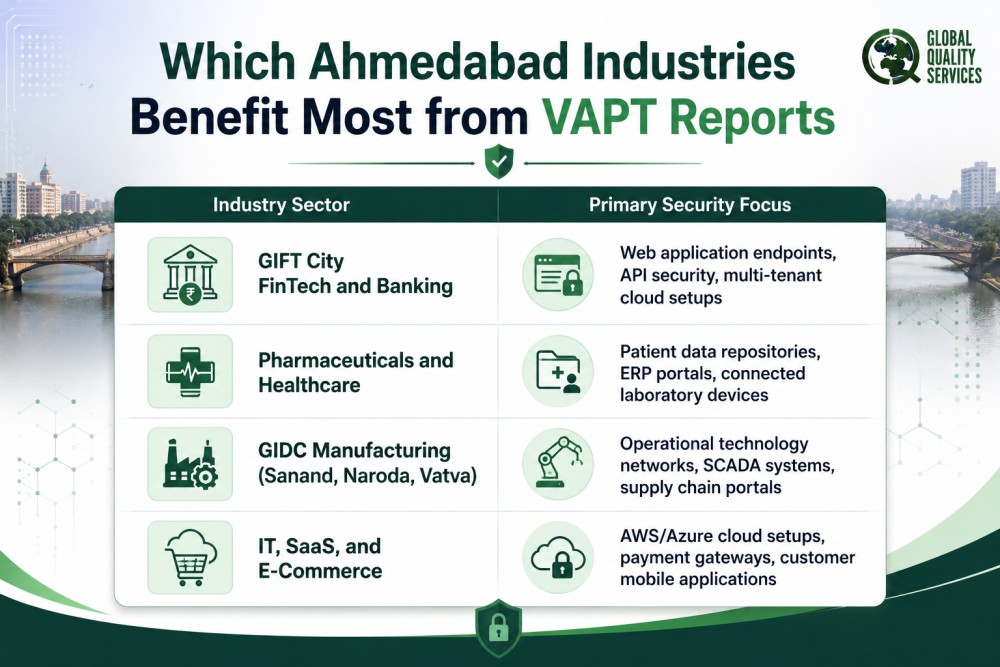
Which Ahmedabad Industries Benefit Most from VAPT Reports
Different commercial sectors face different digital risks. Here is how local sectors use security testing reports:
Our VAPT Reporting Process for Ahmedabad Businesses
Our five-step audit process tests your IT infrastructure and delivers an actionable report without disrupting your operations.
Step 1: Scoping and Rules of Engagement
We review your IT assets, set clear testing boundaries, and agree on timing so testing never disrupts your live services.
Step 2: Dual-Layer Automated and Manual Testing
Certified security auditors run deep software scans combined with manual testing to spot logic errors, access bugs, and setup mistakes automated tools miss.
Step 3: Draft Report Delivery and Technical Walkthrough
We send a draft report featuring a high-level executive summary for management, alongside technical vulnerability logs and proof-of-concept steps for your engineers.
Step 4: Remediation Guidance and Developer Support
Our team meets with your developers to review findings, offering sample code fixes and server settings to speed up security patching.
Step 5: Verification, Re-Testing and Final Certification
Once your team completes the fixes, we run a free re-test within 30 days to verify every patch and issue your official compliance clearance certificate.
Common Security Risks Found in Ahmedabad Business Environments
These are the most common vulnerabilities discovered during audits of corporate networks, cloud platforms, and web software in Gujarat.
- Broken Access Controls: Flaws that let basic user accounts view restricted administrative records or alter system settings.
- Unsecured API Endpoints: Missing authentication checks on application programming interfaces, leading to data leaks on web or mobile platforms.
- Cloud Misconfigurations: Open storage buckets, default passwords, and overly permissive firewall rules on AWS, Azure, or Google Cloud.
- Outdated Industrial Software: Unpatched operating systems and older software running on manufacturing equipment networks in GIDC industrial areas.
- Unencrypted Data Traffic: Systems transmitting user logins or financial information over plain HTTP without modern encryption protocols.
Why Businesses Choose Global Security Services for VAPT Report Services in Ahmedabad
Global Quality Services deliver clear, audit-ready security reports tailored to local enterprise needs. Instead of giving you raw scanner exports full of false flags, we combine automated scans with hands-on manual testing. This ensures every finding in your report is verified and actionable.
- CERT-In Aligned Format: Our audit reports meet the submission standards required by government bodies, financial regulators, and global auditors.
- Zero False Positive Guarantee: Senior security testers manually confirm every vulnerability before including it in your final report.
- Local Sector Knowledge: We understand local business requirements across Gujarat while running audits to global standards like OWASP, NIST, and ISO 27001.
- Clear Cost Structure: Upfront pricing based on system size, IP counts, and application complexity without surprise fees.
Strengthen Your Cybersecurity with Reliable VAPT Report Services in Ahmedabad
Taking proactive steps to test your software protects your company from breaches and prepares you for enterprise deals. An independent security report satisfies legal requirements, secures client trust, and protects your operational stability.
- Audit-Ready Documentation: Get an official clearance letter and detailed security report recognized by corporate clients and regulatory teams.
- Free 30-Day Re-Testing Support: Confirm your technical patches are working without paying for a second security audit.
- Fast Turnaround: Receive your initial draft report within 3 to 5 business days after testing finishes.
To discuss your testing requirements and secure your digital assets, contact Global Quality Services to get a customized proposal for your systems.
Frequently Asked Questions
1. What is the difference between a Vulnerability Assessment and a Penetration Testing report?
A vulnerability assessment uses automated tools to find known system flaws without exploiting them. A penetration testing report goes further by manually exploiting those flaws to measure real risk and operational impact.
2. How long does it take to complete a VAPT audit and deliver the final report?
Auditing a standard web application or network usually takes 3 to 5 business days, with the draft report delivered right after testing completes.
3. Will VAPT testing slow down our website or cause system downtime?
No. All testing follows agreed rules of engagement to keep your production systems safe. Intense manual tests are scheduled during off-peak hours if necessary.
4. Is re-testing included after our technical team fixes the reported issues?
Yes. We include a free re-test within 30 days to verify that your developers patched all vulnerabilities before we issue your final clearance certificate.
5. Does a VAPT report satisfy the security requirements of the Indian DPDP Act 2023?
Yes. Carrying out regular penetration testing and documenting your security fixes fulfills the data protection requirements outlined under the Digital Personal Data Protection Act.