Quality management is changing on a global scale. According to the International Accreditation Forum annual ISO Survey data, India consistently ranks among the top five markets globally for valid ISO 9001 certificates. This massive footprint underscores how deeply Indian enterprises rely on standardized quality to compete in domestic and export markets.
With the International Organization for Standardization finalizing its draft approvals, the release of the updated ISO 9001:2026 standard is fast approaching. This upcoming update ensures that quality management systems keep pace with rapid digital transformation, supply chain vulnerability, and global sustainability pressures.
For organizations across India currently holding ISO 9001:2015 certification, there is no need for immediate concern. Your current certification remains fully valid throughout the official transition period. However, preparing early is the best way to maintain a smooth operational flow. This comprehensive guide outlines the key changes, how the transition timeline works, and how Global Quality Services can facilitate a seamless upgrade for your business.
What is ISO 9001:2026?
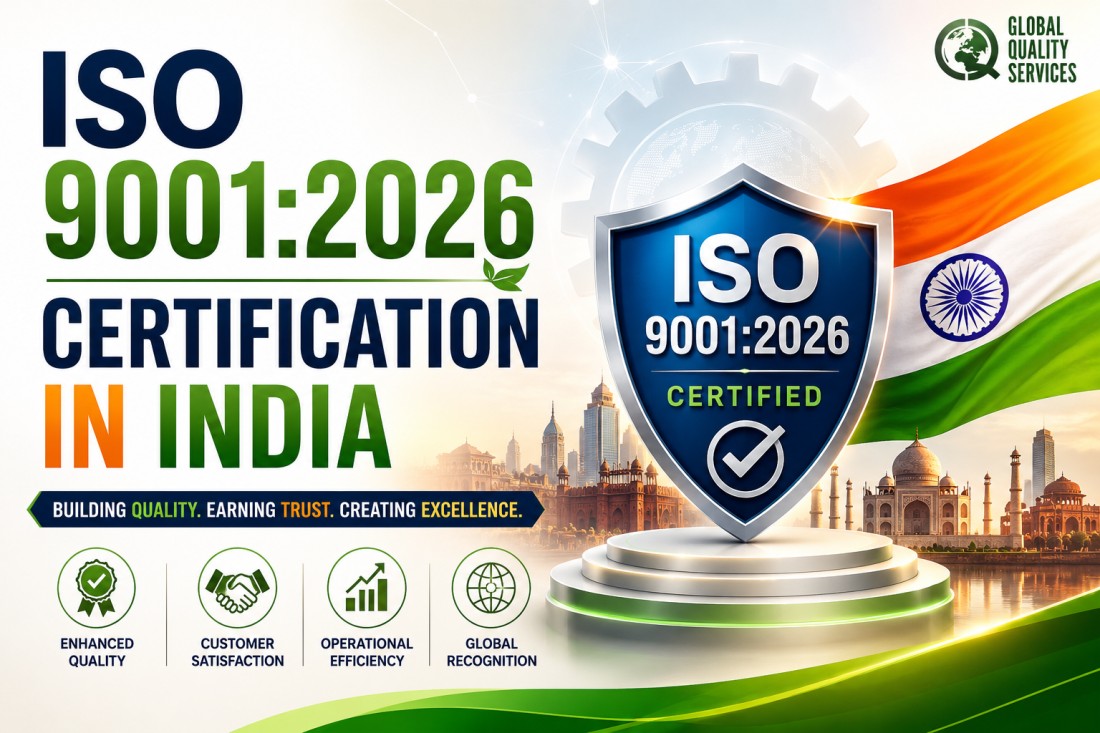
ISO 9001:2026 is the upcoming revision of the ISO 9001 Quality Management System standard developed by the International Organization for Standardization (ISO). The revised version aims to ensure that quality management practices remain relevant for modern businesses and global markets.
Like previous editions, the standard will continue to focus on:
- Customer satisfaction
- Process improvement
- Risk-based thinking
- Leadership involvement
- Evidence-based decision making
- Continual improvement
Why is ISO 9001 Being Updated?
Business environments have changed significantly since ISO 9001:2015 was introduced. Organizations now face new operational, technological, and regulatory challenges. The revision aims to help businesses address:
- Increasing digitalization of business processes
- Complex global supply chains
- Greater focus on organizational resilience
- Changing customer expectations
- Climate-related considerations
- Emerging technologies
- Better management of external and internal business contexts
ISO 9001:2015 vs. ISO 9001:2026: Key Differences Explained
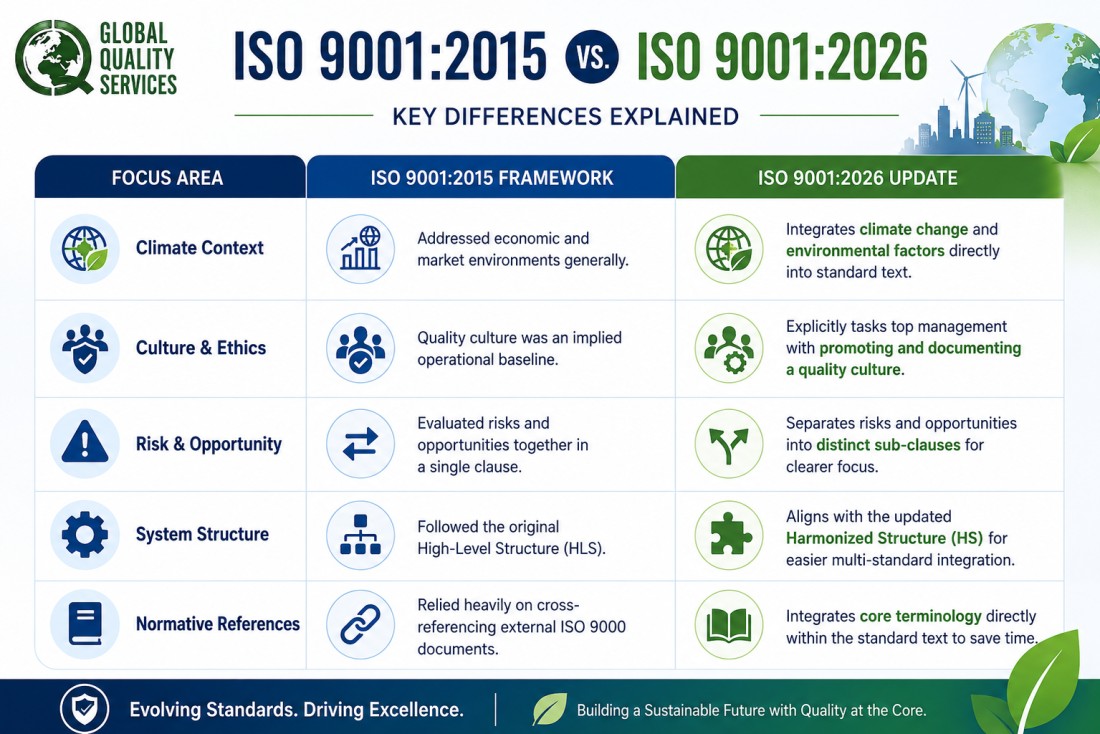
The upcoming 2026 version acts as a practical refinement rather than a complete replacement of the old system. It keeps the familiar ten-clause structure and process-oriented focus of the 2015 version while introducing sharper requirements to help modern businesses handle real-world challenges.
1. Clear Integration of Climate and Sustainability Context
While the 2015 standard focused on general market and economic surroundings, the 2026 update explicitly builds climate change considerations into the framework. Certified organizations must now assess whether environmental shifts, resource scarcity, or carbon-reduction regulations affect their ability to deliver consistent product and service quality.
2. Focus on Quality, Culture, and Ethical Conduct
The new version moves workplace culture from an unwritten rule to an explicit leadership focus. Top management is now expected to actively encourage and document a healthy quality culture and ethical behavior across all operations, ensuring that collective values directly support product reliability.
3. Separation of Risks and Opportunities
Under ISO 9001:2015, risk-based thinking often leads businesses to focus on avoiding problems while overlooking growth opportunities. The 2026 version fixes this by splitting risks and opportunities into completely separate sub-clauses, requiring teams to systematically spot and act on positive business opportunities.
4. Alignment with the Modern Harmonized Structure
To make multi-standard systems much easier to manage, the 2026 edition updates its core terms and definitions to match the latest ISO Harmonized Structure. This change makes it simple to blend your quality system with other standards like ISO 14001 for environmental management or ISO 45001 for workplace safety.
The Strategic Transition Roadmap and Timeline
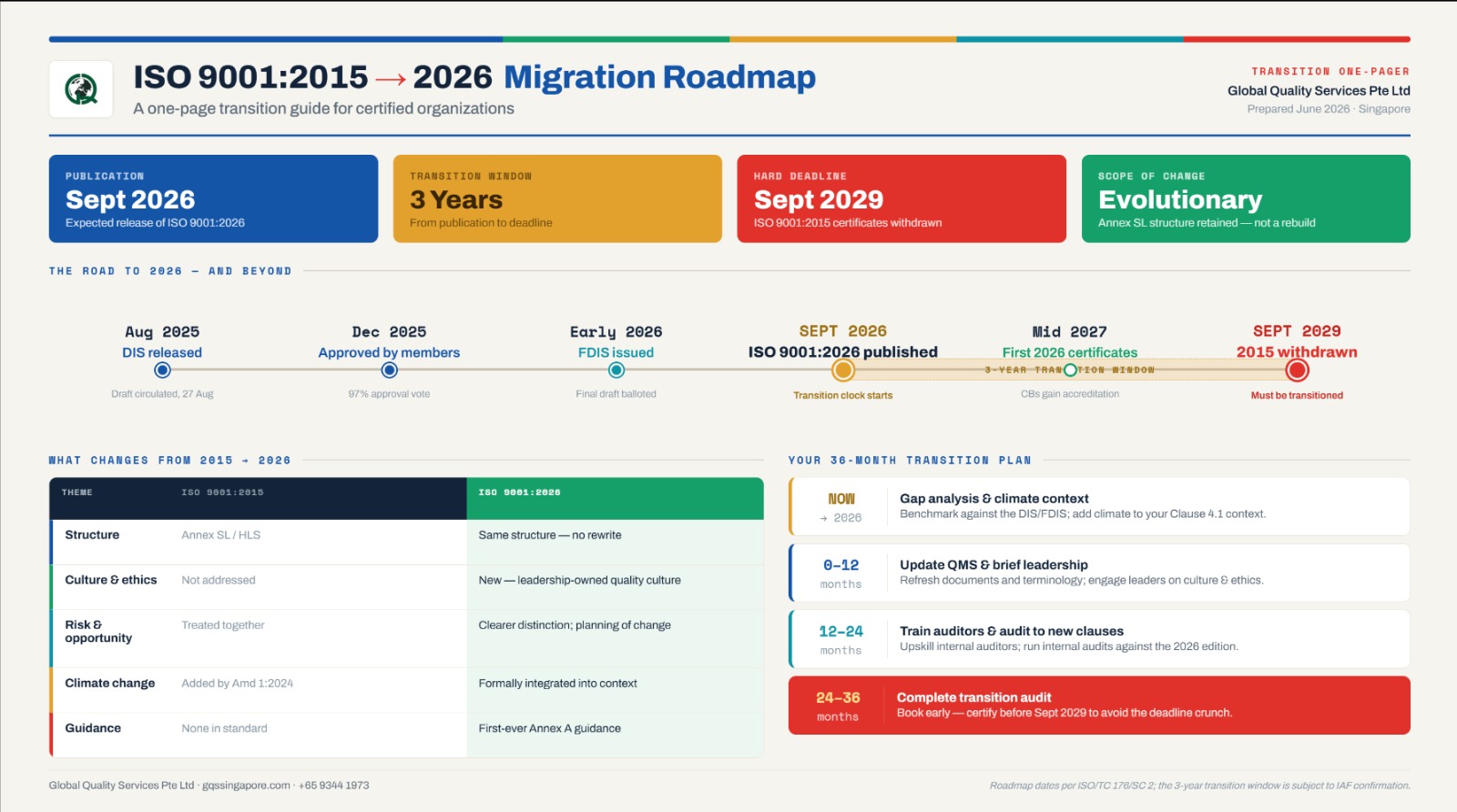
The International Organization for Standardization allows a structured three-year transition window for businesses updating from the 2015 version to the 2026 standard. Once the standard is officially published in 2026, the current ISO 9001:2015 version will remain valid until late 2028 or early 2029. Companies have until early 2027 to comfortably map out and kick off their migration strategy.
To avoid a last-minute scramble and protect your daily operations, we recommend breaking the migration down into structured, yearly phases:
- Months 0 to 12: Discovery and Gap Analysis: The initial year centers on identifying changes. Organizations perform a detailed gap analysis against the new rules, focusing on how climate factors impact their business context. During this time, teams update their documentation and conduct core briefing sessions for leadership.
- Months 12 to 24: Process Updates and Practical Auditing: In the second phase, updated processes go live across the company. Internal auditors evaluate the system using the new criteria, checking that the updated approach to culture, ethics, and opportunity planning is working well in daily routines.
- Months 24 to 36: Final Migration Audits: The last twelve months are reserved for official certification reviews. Registered auditors evaluate the updated system to confirm full compliance with the 2026 standard, officially issuing your new certificate well ahead of the final expiration date of the 2015 version.
Who Should Prepare for ISO 9001:2026?
The revised standard will impact organizations across industries, including:
- Manufacturing: Automotive, engineering, electronics, textiles, chemicals, and industrial production.
- Information Technology: Software companies, IT service providers, SaaS businesses, and technology startups.
- Healthcare: Hospitals, medical device manufacturers, laboratories, and healthcare service providers.
- Construction and Infrastructure: Builders, contractors, consultants, and project management firms.
- Logistics and Supply Chain: Warehousing, transportation, freight forwarding, and distribution companies.
- Education and Service Industries: Educational institutions, consulting firms, training organizations, and professional service providers.
ISO 9001:2026 Certification Consultants in India
ISO 9001:2026 Certification in Delhi | ISO 9001:2026 Certification in Bengaluru
ISO 9001:2026 Certification in Noida | ISO 9001:2026 Certification in Hyderabad
ISO 9001:2026 Certification in Ahmedabad | ISO 9001:2026 Certification in Chennai
ISO 9001:2026 Certification in Pune | ISO 9001:2026 Certification in Mumbai
How Global Quality Services Support You For ISO 9001:2026 Certification
We have supported certified businesses across India through every major ISO 9001 revision, and the move to the 2026 edition is no different. Here is exactly what our team takes care of:
- Gap analysis against the new clauses: Our auditors review your existing QMS clause by clause and map precisely what needs updating for the climate context, leadership responsibility, and the restructured risk requirements.
- Documentation and QMS updates: We help rewrite policies, risk registers, and procedure documents so they reflect the 2026 requirements without disrupting the processes your teams already follow.
- Leadership and team training: Practical sessions for management and staff covering quality culture, ethical conduct expectations, and how the revised risk and opportunity clauses apply to everyday work.
- Internal audits and transition support: We run internal audits ahead of your certification body’s transition audit, so non-conformities get caught and resolved early, not during the final assessment.
- Scheduling and certificate coordination: We help you book your transition audit well ahead of the year three rush and manage the paperwork so your certificate updates without any gap in validity.
- Ongoing compliance support: Once you are certified under ISO 9001:2026, we continue supporting surveillance audits and process improvements so your QMS stays current well beyond the transition itself.
Secure a Seamless Transition with Global Quality Services
Starting your ISO 9001:2026 transition early helps avoid last-minute pressure, reduces operational disruptions, and gives your team enough time to adapt to the updated requirements. A planned approach makes the transition smoother and more cost-effective.
At Global Quality Services, we are a specialized ISO consultancy in India, helping businesses prepare for the transition to ISO 9001:2026. As implementation consultants, we support gap assessments, documentation updates, training, pre-audits, and overall system readiness for the official certification process. We are not a certification body but your trusted partner in achieving compliance.
Get in touch with Global Quality Services today to plan a timely and hassle-free ISO 9001:2026 transition and keep your business ahead of the changing quality standards.
Important Note: While ISO 9001:2015 will continue to be valid during the official transition period, businesses that start planning early can spread implementation activities over time and avoid last-minute compliance pressures. Global Quality Services can help you prepare for a smooth and timely transition to ISO 9001:2026.
Frequently Asked Questions
1. Is ISO 9001:2026 officially available?
The revised standard is expected to be published in 2026. Businesses should start understanding the expected changes and preparing for the transition.
2. Will my ISO 9001:2015 certificate become invalid immediately?
No. Existing certificates will remain valid during the official transition period established after the publication of ISO 9001:2026.
3. Do I need to obtain a completely new certification?
No. Existing certified organizations will generally complete a transition process to the updated version rather than starting from scratch.
4. When should businesses start preparing?
Organizations should begin planning their migration early. Starting before 2027 allows sufficient time for assessment, system updates, and implementation.
5. What are the major expected changes?
The revised standard is expected to place greater emphasis on organizational resilience, digital transformation, changing business environments, leadership involvement, and evolving risk management practices.