Payment software is supposed to do more than just function correctly. It needs to keep data safe, facilitate secure transactions, and pass stringent security assessments. In Mumbai, this is particularly crucial because of the fintech ecosystem. There are over 500 fintech companies in Mumbai, creating over 2,500 employment opportunities, according to the Government of Maharashtra’s Mumbai FinTech Hub.
The PCI Software Security Framework (PCI SSF) is a methodical approach that enables software vendors to demonstrate secure software development within their products and processes. The Secure Software Standard of PCI SSC was revised to version 2.0 in January 2026, while the Secure Software Lifecycle Standard was revised to version 2.0 in September 2026.
Knowing these changes can save a lot of time for fintech startups in Mumbai, payment software vendors, SaaS providers, and tech firms. You will learn about PCI SSF requirements, PCI SSF v2.0 enhancements, assessment preparation tips, costs, timeframe considerations, and how GQS can help your organization.
What is PCI Software Security Framework Certification in Mumbai?
PCI Software Security Framework Certification refers to the preparation of software for PCI SSF assessment and certification.
The PCI SSF applies to organizations involved in producing software that enables or facilitates payment processes. The PCI SSC Secure Software Standard is meant to address software security in terms of development and maintenance, whereas the Secure Software Lifecycle Standard addresses security in relation to the entire lifecycle of the development process. Essentially, the certification program helps companies prove that security considerations are taken into account during software development instead of being handled separately afterwards.
If you are based in Mumbai, the PCI SSF becomes important whenever there are demands from clients, partners, banks, or any other parties regarding the security of payment-related software.
PCI SSF Covers Two Key Standards
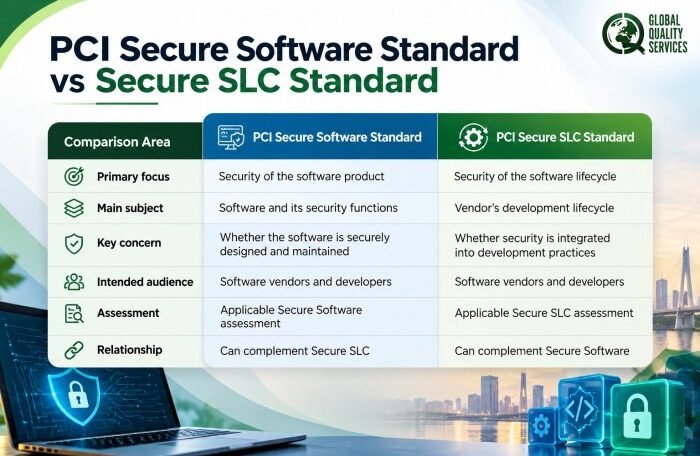
PCI Secure Software Standard
This focuses on the security of the software product itself, including how it protects payment-related functionality and sensitive assets.
PCI Secure Software Lifecycle Standard
This focuses on the vendor’s software development lifecycle and how security is integrated into design, development, deployment, maintenance, and related activities.
Who Needs PCI SSF Certification in Mumbai?
PCI SSF is primarily relevant to software vendors and developers whose products are used in payment environments. PCI SSC identifies software vendors developing payment software as the intended audience for the Secure Software Standard. Businesses that may need to consider PCI SSF include:
- Payment software vendors
- Payment gateway technology providers
- Fintech software companies
- Payment processing software developers
- POS software providers
- Mobile payment application developers
- Banking technology providers
- Card management software providers
- Payment switching software providers
- SaaS companies supporting payment environments
- Software vendors serving banks and financial institutions
- Technology companies whose customers require PCI SSF validation
Why PCI SSF Matters for Mumbai’s Fintech and Software Businesses
Mumbai has its own fintech ecosystem thanks to initiatives such as the Mumbai FinTech Hub, an initiative backed by the Government of Maharashtra. According to the initiative, there are currently over 500 fintech firms operating within the ecosystem. Software security is important for businesses that wish to build trust among customers, increase sales, make payments easy, and acquire products and services. PCI SSF could benefit organisations by:
- Demonstrate a structured approach to software security
- Identify security weaknesses before formal assessment
- Protect sensitive software assets
- Strengthen secure development practices
- Improve security assurance for customers
- Support payment industry requirements
- Prepare evidence for independent assessment
- Build stronger security controls into the software lifecycle
PCI SSF v2.0: What Mumbai Software Vendors Need to Know in 2026
PCI SSC published version 2.0 of the PCI Secure Software Standard on January 15, 2026 – the first revision since its launch. Here’s what has changed and what software vendors must know for compliance purposes.
Sensitive Asset Identification
One new component added in version 2.0 is the Sensitive Asset Identification Document. This can help organizations assess what constitutes sensitive assets in their software, providing justification for specific controls within the software environment.
Software Development Kits
Version 2.0 now permits software development kits, such as those from EMVCo 3DS, to be subject to the PCI Secure Software Standard via assessment.
Updates to Software Updates
Version 2.0 also includes modifications to how some software updates may be handled. These include wildcard provisions for minor changes without security implications, as well as modified rules around delta changes.
Annual Attestations and Portal Changes
Finally, the revised program introduces portal capabilities for annual attestation submissions by software vendors.
What Changed With Secure SLC v2.0?
The PCI Software Security Framework has received its second major standard release with the launch of Secure Software Lifecycle Standard version 2.0 on September 28, 2026, by PCI SSC. The updated standard is in line with the new Secure Software Standard while emphasizing considerations for:
- Sensitive assets
- Software development lifecycle
- Digital tools
- Use of artificial intelligence during Secure SLC operations
- Adaptive requirements based on vendor maturity
PCI SSC also notes that although both standards complement each other, fulfilling one compliance requirement does not necessarily mean fulfilling the other.
PCI Secure Software Standard vs Secure SLC Standard
PCI SSF vs PCI DSS: What Is the Difference?
The PCI SSF and PCI DSS apply to separate aspects of payment security. While PCI SSF relates to software and secure software development practices, the PCI DSS sets out security requirements applicable to organizations that store, process, or transmit payment card data.
In this regard, a software provider has to consider PCI SSF regardless of whether the primary obligation under consideration lies with respect to developing software products or running a cardholder data environment.
It is possible that for certain companies, the two frameworks will overlap. The scope must be determined based on the organizational context, including services offered, technologies deployed, payment processes, and contractual agreements.
PCI SSF Certification Process in Mumbai
Preparing for a PCI SSF assessment isn’t just about gathering your policies. You’ll need to ensure your software, development processes, security controls, and documentation are ready to be assessed.
Step 1: Identify the PCI SSF Scope
In this step, you define which software, components, development operations, sensitive data, systems, and functionalities are part of the PCI SSF scope. It will help clarify which PCI SSF requirements you should focus on and keep unnecessary controls out of the assessment process.
Step 2: Perform a PCI SSF Gap Assessment
You assess your current security controls and development operations against the selected PCI SSF requirements. The gap assessment uncovers any controls, documentation, or evidence deficiencies, security vulnerabilities in the software itself, and shortcomings in your organization’s security posture.
Step 3: Address Security Gaps and Prepare Evidence
Identified gaps are addressed through suitable technical, operational, and documentation improvements. Evidence can include security testing records, architecture documents, code review records, vulnerability management information, change records, policies, procedures, and other supporting material.
Step 4: Conduct a Readiness Review and Formal Assessment
In the context of cybersecurity frameworks, a readiness review serves as an initial checkpoint before conducting a formal assessment. After passing this stage, the designated assessor evaluates the requirements and checks associated controls and documentation.
Step 5: Validate and Remain Compliant
Once the assessment phase has concluded, any necessary reporting and validation processes will follow. It falls on the organization to continue maintaining its controls and fulfill all other ongoing obligations.
Documents and Evidence Needed for PCI SSF Assessment
The exact evidence depends on the scope and applicable requirements. However, software vendors commonly need documentation and records covering areas such as:
- Software architecture
- System and data-flow diagrams
- Sensitive asset identification
- Secure development policies
- Secure coding practices
- Access control procedures
- Authentication controls
- Vulnerability management
- Security testing
- Code review records
- Change management
- Software update procedures
- Risk assessment
- Incident response
- Security monitoring
- Third-party components
- Development lifecycle procedures
- Security training
- Remediation records
Common PCI SSF Gaps Found in Software Companies
Software companies often have security controls in place but struggle to demonstrate them consistently. Common problem areas include:
- Security Documentation Gaps: The company can practice its own security controls but lacks any documentation outlining its approach to managing them.
- Evidence Management Issues: Control measures could be implemented, yet the supporting documentation would be dispersed across several platforms or hard to retrieve in assessments.
- Discrepancies in Secure Coding Practices: Different developers might use different methods of assessing, reviewing, and handling vulnerabilities in their code.
- Change Management Flaws: New updates to the program might ship without appropriate documentation tracking the security considerations involved.
- Inaccurate Inventory of Sensitive Assets: Developers could lack awareness about their critical resources and the means employed to protect these resources.
- Misalignment of Policies With Actual Procedures: An organization’s policies might describe one process, whereas its development staff adhere to another method.
How Long Does PCI SSF Certification Take in Mumbai?
There is no single timeline that applies to every software vendor. The project duration depends on factors such as:
- Number of software products in scope
- Software architecture
- Complexity of the development environment
- Existing security controls
- Number of identified gaps
- Code review requirements
- Availability of evidence
- Development team involvement
- Remediation requirements
- Assessor availability
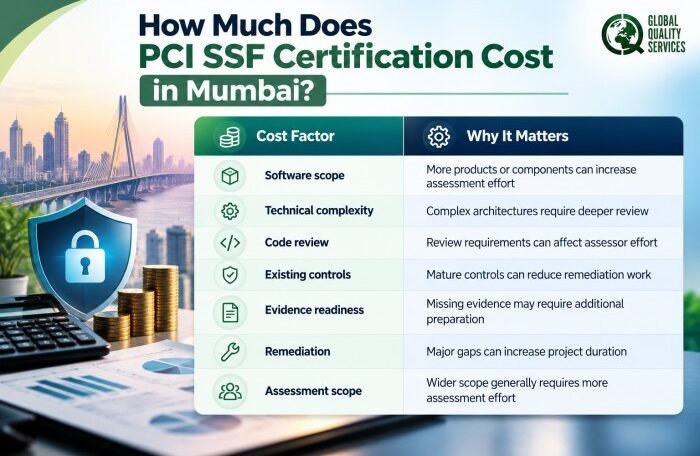
How Much Does PCI SSF Certification Cost in Mumbai?
PCI SSF Support for Businesses Across Mumbai
GQS provides compliance support for businesses operating across Mumbai’s major commercial and technology centres, including Bandra Kurla Complex, Andheri, Powai, Lower Parel, Goregaon, Malad, Navi Mumbai and Thane.
Support can be structured around the organisation’s software environment, development practices, security controls, documentation, and assessment requirements.
Whether you are a growing fintech company, an established payment technology provider, or a software vendor serving enterprise clients, the preparation approach should be based on your actual technology environment rather than a generic checklist.
PCI SSF and ISO 27001: How They Can Work Together
PCI SSF and ISO 27001 certification address different compliance needs.
PCI SSF focuses specifically on secure software and the software lifecycle within the PCI Software Security Framework, while ISO 27001 provides a broader information security management system framework.
For technology businesses handling multiple customer security requirements, both may form part of a wider information security programme. The right combination depends on the organisation’s customers, contracts, technology environment, and regulatory obligations.
Why Choose Global Quality Services for PCI SSF Support in Mumbai
Selecting the right consultant matters because PCI SSF preparation involves both technical security and detailed evidence requirements. GQS focuses on making the preparation practical for the organisation’s existing systems rather than treating compliance as paperwork alone.
- 26 Years of Compliance Experience
- Expertise in PCI DSS, SOC 2, ISO 27001 and Security Standards
- Experienced Compliance Consultants
- Practical Software Security Expertise
- Strong Documentation and Evidence Support
- PCI SSF v2.0 Readiness Support
- Pan-India Compliance Support
- Client-Focused Compliance Approach
Get PCI SSF Assessment Support in Mumbai From Global Quality Services
Prepare your software for PCI SSF v2.0 assessment and validation with experienced compliance consultants. Global Quality Services can help your team assess its current security posture, identify gaps, strengthen documentation, organise evidence, and prepare for the formal assessment.
Contact GQS today to discuss your software scope, PCI SSF requirements, assessment needs, and project timeline, and receive a practical compliance plan for your Mumbai-based organisation.
Frequently Asked Questions
1. What is PCI Software Security Framework Certification?
PCI Software Security Framework Certification is a commonly used term for the process of assessing and validating software or software lifecycle practices against applicable PCI SSF requirements. PCI SSF includes the Secure Software Standard and the Secure Software Lifecycle Standard.
2. Is PCI SSF mandatory for software companies in Mumbai?
Not every software company is automatically required to undergo PCI SSF assessment. Whether validation is required depends on applicable payment brand programmes, customer requirements, contracts, and the organisation’s role in the payment ecosystem. PCI SSC notes that compliance programmes for its standards are managed by payment brands.
3. Who performs a PCI SSF assessment?
A qualified PCI SSC assessor performs the applicable independent assessment. Organisations should verify the assessor’s qualification and scope through the PCI SSC assessor listing.
4. What is the difference between PCI SSF certification and PCI SSF validation?
Certification is commonly used in commercial searches to describe PCI SSF compliance. PCI SSC’s programme uses assessment and validation terminology, with qualified assessors evaluating applicable requirements and completing the relevant reporting and validation activities.
5. What is PCI SSF v2.0?
PCI SSF v2.0 refers to the updated PCI Secure Software Standard v2.0 and the newer Secure Software Lifecycle Standard v2.0. The Secure Software Standard was released in January 2026, followed by Secure SLC v2.0 in September 2026.