Digital payments in Chennai have reached unprecedented levels, ranging from e-commerce transactions to fintech transactions, subscription billing, and online service billing. As such, cybersecurity has become critical when securing customer payment data. In 2025, Chennai’s cybercrime cells received 2,203 complaints regarding cybercrimes, recovering ₹25.97 crore from people defrauded online, according to reports published by The Times of India in January 2026.
Businesses dealing with payment cardholder data must ensure they comply with the PCI DSS framework, creating robust controls for securing payment details and mitigating security threats. PCI DSS v4.0.1 is the currently active version of the standard.
Global Quality Services supports Chennai-based companies with PCI DSS compliance management services. We help clients comprehend their PCI DSS requirements, assess gaps, implement improved controls, document findings, and prepare for certification. Learn more about PCI DSS compliance, the assessment process, and GQS’ assistance in this article below.
What is PCI DSS Certification?
PCI DSS stands for Payment Card Industry Data Security Standard. It is a global security standard that protects payment account data and sets security requirements for organisations that store, process, or transmit cardholder data. It applies to merchants, payment service providers, e-commerce companies, fintech firms, financial organisations, hospitality businesses, and technology service providers.
Understanding PCI DSS v4.0.1 Compliance
The Payment Card Industry Data Security Standard is an international security framework governed by the PCI Security Standards Council. The active release, PCI DSS v4.0.1, introduces stringent technical expectations around identity management, payment page protection, customized risk analysis, and continuous monitoring.
Compliance applies to two major categories of businesses:
- Merchants: Commercial entities that accept credit, debit, or prepaid card payments for goods or services.
- Service Providers: Organizations directly involved in processing, storing, transmitting, or managing environments that impact cardholder data security.
PCI DSS v4.0.1 is the current active version, with requirements covering vulnerability management, authentication, payment page security, monitoring, risk analysis, and third-party relationships. It is not a conventional ISO-style certification scheme. The PCI Security Standards Council does not recognise generic compliance certificates as official evidence of PCI DSS validation. Depending on the applicable validation route, organisations may need a Report on Compliance (ROC), Attestation of Compliance (AOC), Self-Assessment Questionnaire (SAQ), and applicable ASV scan evidence.
Why Chennai Tech Hubs Need Payment Security Readiness
Chennai has established itself as one of India’s most prominent technology and financial software corridors. From fintech startups along Old Mahabalipuram Road to IT service centers in Taramani, Guindy, and Ambattur Industrial Estate, thousands of enterprises process payment transactions daily for domestic and global clients. Local businesses face specific operational realities:
- Fintech and Payment Gateways: Local startups require rapid compliance validation to onboard banking partners and merchant acquirers without delay.
- Software Exporters and BPOs: Global enterprise clients demand verified proof of payment security before awarding international outsourcing contracts.
- E-Commerce and Retail Chains: Online merchants and multi-location stores require secure point-of-sale integration and payment checkout protection.
Who Needs PCI DSS Compliance in Chennai?
PCI DSS is relevant to a broad range of Chennai businesses.
- E-commerce and Online Retail
- Fintech and Payment Companies
- Banks and Financial Services
- IT and SaaS Companies
- BPO and Shared Service Centres
- Hospitality and Travel
- Healthcare Businesses
- Retail and Physical Stores
Benefits of PCI DSS Certification
Achieving PCI DSS Certification offers several advantages for businesses in Chennai:
- Improved Data Security: Strengthen your payment systems against cyber threats and breaches.
- Regulatory Compliance: Meet global standards required by payment card brands.
- Customer Trust: Reassure customers that their card data is processed safely and securely.
- Reduced Risk: Minimize financial losses, penalties, and reputation damage from data breaches.
- Competitive Edge: Gain an advantage when dealing with global clients and partners who prioritize data security.
What Are the Main PCI DSS Requirements in Chennai
PCI DSS v4.0.1 contains 12 core requirement areas covering the security of payment card data and the systems that support its processing.
- Install and Maintain Network Security Controls: Organisations need appropriate network security controls to protect the cardholder data environment and restrict unauthorised access.
- Apply Secure Configurations: Systems, applications and network devices need secure configurations. Default passwords and unnecessary settings should not remain in use.
- Protect Stored Account Data: Organisations must establish appropriate controls for protecting stored payment account data and limiting unnecessary retention.
- Protect Cardholder Data During Transmission: Cardholder data transmitted over open or public networks must be protected using appropriate security measures.
- Protect Systems From Malicious Software: Businesses need processes and technical controls to detect and address malware and related security threats.
- Develop and Maintain Secure Systems and Software: Security needs to be considered throughout system development, vulnerability management, patching, and software maintenance.
- Restrict Access Based on Business Need: Access to payment systems and cardholder data should be limited according to business need and user responsibilities.
- Identify Users and Authenticate Access: Organisations need appropriate user identification and authentication controls, including stronger authentication measures where required.
- Restrict Physical Access: Physical access to systems and environments containing payment information must be appropriately controlled.
- Log and Monitor Access: Organisations need to monitor relevant access and activities involving systems and cardholder data to support detection and investigation.
- Regularly Test Security Systems and Processes: Security controls need to be tested and reviewed to identify vulnerabilities and verify that security measures continue to work as intended.
- Maintain an Information Security Policy: Organisations need policies and supporting procedures that define security responsibilities and expectations across the business.
Why Chennai Businesses Should Start PCI DSS Preparation Early
Waiting until a customer, acquirer, or business partner requests PCI DSS evidence can create unnecessary pressure. Early preparation gives your organisation time to:
- Understand its actual PCI DSS scope
- Identify security gaps
- Review payment data flows
- Improve network controls
- Strengthen access management
- Fix vulnerabilities
- Prepare documentation
- Collect evidence
- Review third-party relationships
- Prepare employees
- Resolve issues before the formal assessment
PCI DSS Compliance Validation in Chennai
There is no single validation route that applies to every organisation. The appropriate validation method can depend on factors such as:
- Whether the organisation is a merchant or service provider
- Transaction volumes
- Payment brands involved
- Acquirer requirements
- Cardholder data environment
- Payment processing model
- Contractual obligations
- Applicable Self-Assessment Questionnaire
- Whether a formal ROC is required
PCI DSS Compliance Levels
PCI DSS Certification requirements vary depending on the number of transactions your business processes annually. There are four levels of compliance:
- Level 1: Over 6 million transactions per year
- Level 2: Between 1 million and 6 million transactions
- Level 3: Between 20,000 and 1 million transactions
- Level 4: Fewer than 20,000 transactions
Each level requires specific validation methods such as Self-Assessment Questionnaires (SAQ), vulnerability scans, or on-site audits conducted by a Qualified Security Assessor (QSA).
The PCI DSS Certification Process
Global Quality Services follows a systematic approach to help organizations achieve PCI DSS Certification in Chennai:
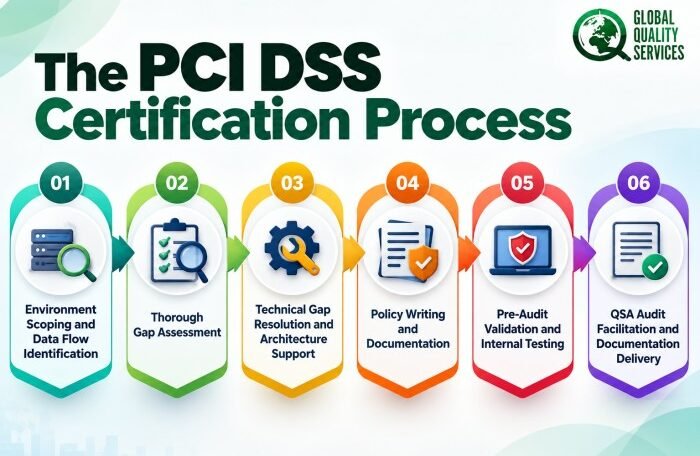
Step 1: Environment Scoping and Data Flow Identification
Your environment gets evaluated to find out every place card data flows through, travels over, or gets stored within. Environment scoping avoids auditing anything outside the necessary scope, saving time.
Step 2: Thorough Gap Assessment
Our specialists conduct a comprehensive analysis against PCI DSS requirements 1-12 in order to uncover gaps in your current security stance. Log files, encryption keys, firewalls, and administrative configurations are assessed to detect gaps.
Step 3: Technical Gap Resolution and Architecture Support
We give exact guidance on how to close the discovered security gaps. Your advisor helps configure multi-factor authentication, create network segmentation, secure servers, and deploy intrusion detection solutions.
Step 4: Policy Writing and Documentation
Adherence demands documented and enforced security standards. Our services include custom-written security policies, incident response plans, access control policies, and procedure documentation, which will fit into your unique work environment.
Step 5: Pre-Audit Validation and Internal Testing
As a prelude to engaging any outside parties in auditing activities, we conduct a full-scale test run within your own network infrastructure. In this simulation audit, we verify that all technical controls behave as expected and that your staff has collected all necessary documentation required for your compliance audit.
Step 6: QSA Audit Facilitation and Documentation Delivery
We support your organization’s personnel throughout the final round of review conducted by a Qualified Security Assessor. During this phase, we coordinate the submission of evidence and answer technical questions.
PCI DSS Certification Cost in Chennai
PCI DSS compliance costs vary based on the organisation’s size, systems, security setup, and assessment requirements. There is no fixed price for PCI DSS Certification in Chennai. Key cost factors include:
- Organisation and network size
- Cardholder data environment
- Payment processing model and transaction volume
- Number of locations and third parties
- Existing security controls and documentation
- Vulnerability scanning and penetration testing
- Assessment and validation requirements
- External assessor involvement
How Long Does PCI DSS Compliance Take in Chennai
The timeline depends on the current security maturity and complexity of the organisation. A company with established security controls, complete documentation, and a clearly defined cardholder data environment may move through preparation faster. Businesses starting from a less mature security environment may need additional time for:
- Scope definition
- Gap remediation
- Technical control implementation
- Vulnerability remediation
- Documentation
- Security testing
- Evidence collection
- Internal reviews
PCI DSS and ISO 27001: Building a Stronger Security Framework
The PCI DSS concentrates exclusively on payment card data and related processes. ISO 27001 offers a more holistic approach to building an Information Security Management System (ISMS).
Companies dealing with both payment data and general enterprise information may consider implementing both programs together to avoid duplicate efforts in areas where controls intersect. Those who seek to pursue an ISMS certification should check out GQS’s ISO 27001 Certification services in Chennai as well.
Why Choose Global Quality Services for PCI DSS Certification
Global Quality Services (GQS) is a trusted compliance partner offering expert guidance for PCI DSS Certification. Our consultants bring deep experience in information security and payment data compliance:
- 26+ Years of Compliance Experience: GQS brings over 26 years of experience in certification, auditing, and compliance consulting across global standards.
- PCI DSS-Focused Expertise: Get practical guidance tailored to your payment environment, cardholder data flow, systems, and business requirements.
- Chennai-Based Support: Our team supports businesses across Chennai with responsive consulting, assessment preparation, documentation, and audit coordination.
- Business-Specific Approach: We do not rely on one-size-fits-all checklists. Our recommendations are aligned with your actual systems, processes, and compliance scope.
- End-to-End Assistance: From gap assessment and remediation guidance to evidence preparation and assessment readiness, GQS supports you throughout the compliance journey.
- Strong Information Security Background: Our experience across PCI DSS and related security standards helps businesses build controls that support wider information-security objectives.
- Clear, Practical Guidance: We simplify complex PCI DSS requirements into actionable steps your technical and management teams can understand and implement.
Start Your PCI DSS Compliance Project in Chennai With Global Quality Services
Payment security isn’t just about IT—it goes beyond that into the realms of building consumer confidence, maintaining commercial relationships, facilitating payments, and partnering with organizations with strict requirements regarding security controls. Payment security is important because it impacts more than just your internal IT team—it touches everything from consumer trust to business partnerships, payment processes, and cooperation with firms having rigorous standards around security controls.
Global Quality Services offers services such as PCI DSS consulting and assurance to firms located in Chennai, India. Their services include assessment of organizational requirements, detection of deficiencies, enhancement of controls, and readiness for the relevant certification process.
Speak with a GQS PCI DSS consultant to review your payment environment, understand your compliance requirements, and get a scope-based proposal for your organisation.
Frequently Asked Questions
1. Is PCI DSS Certification mandatory for all businesses in Chennai?
PCI DSS applies to organisations involved in payment card processing, including merchants and service providers. However, the exact validation and reporting obligations depend on the organisation’s role, payment environment, and requirements set by the relevant payment brands, acquirers or other compliance-accepting entities.
2. Does PCI DSS apply if we use a third-party payment gateway?
Using a third-party payment gateway does not automatically remove PCI DSS responsibilities. The scope and validation requirements depend on how your organisation’s payment environment is designed and what functions remain under your control.
3. Does a small business in Chennai need PCI DSS?
PCI DSS is intended for entities involved in payment processing regardless of size. However, small businesses may have a simpler environment and potentially less complex compliance work. The applicable validation requirements should be confirmed with the relevant acquirer or payment brand.
4. What is a QSA in PCI DSS?
A Qualified Security Assessor is a professional qualified through the PCI Security Standards Council’s QSA programme to perform PCI DSS assessments. Where a formal QSA assessment is required, the QSA evaluates the organisation’s applicable PCI DSS controls and assessment evidence.
5. How often should PCI DSS compliance be reviewed?
The required validation frequency depends on the applicable PCI DSS validation route and the requirements of the relevant compliance-accepting entity.