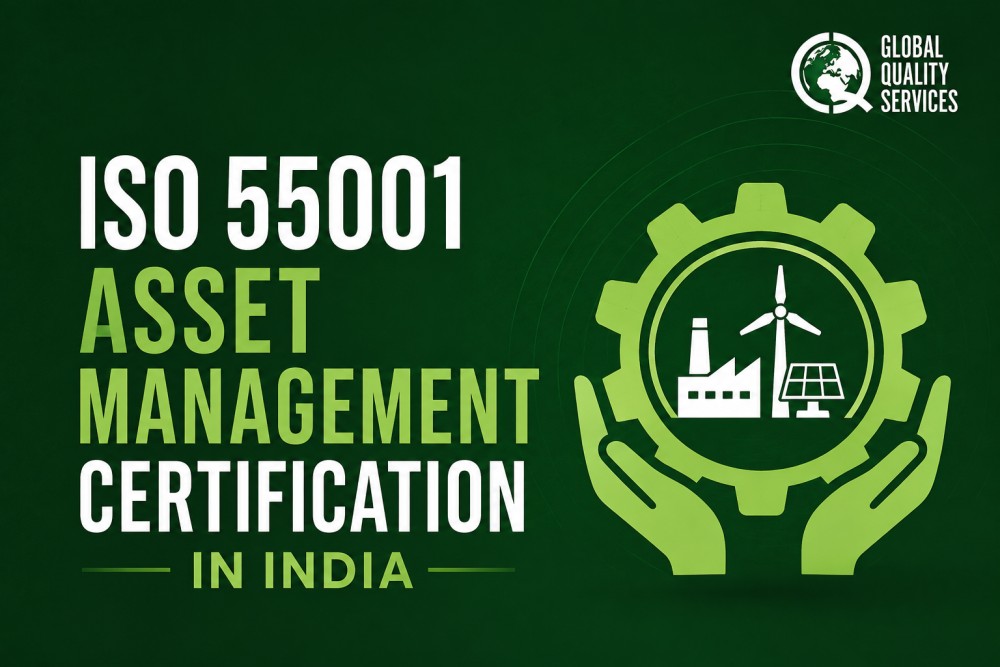
ISO 55001 Certification is becoming popular among Indian organizations because it helps them manage assets better and cut long-term costs. A recent update by BSI Group highlights that the 2024 revision of the ISO asset-management standards now focuses more on lifecycle planning, cost control, risk prevention, and sustainability.
With industries growing and infrastructure expanding, this certification helps businesses improve asset reliability, stay compliant, and build stronger trust with investors. That’s why working with an experienced consultant like Global Quality Services makes the process smoother, faster, and far more effective.
What is ISO 55001 Certification?
ISO 55001 certification is an international standard that helps organizations manage their physical assets like equipment, infrastructure, and machinery in a structured and efficient way.
It ensures you track, maintain, and optimize assets throughout their lifecycle, reducing risks and costs while improving performance. Businesses use ISO 55001 to make smarter decisions, increase reliability, and achieve long-term value from their assets.
Benefits of ISO 55001 Certification in India
ISO 55001 offers powerful advantages that improve asset performance, reduce long-term costs, and strengthen operational reliability across industries. Companies can also follow other certifications for better coverage, like ISO 20000, ISO 13485, and more. Let’s explore its key benefits.
- Improved Asset Performance: It helps organizations control risks and reduce breakdowns through planned and proactive management.
- Reduced Operational Costs: The standard encourages long term planning and preventive maintenance. This lowers repair costs and minimizes unexpected downtime.
- Stronger Risk Management: The framework identifies potential asset failures in advance. This allows businesses to take corrective actions before major issues arise.
- Better Decision Making: A structured system provides accurate data. Leadership can use this data to make informed investment and lifecycle decisions.
- Increased Stakeholder Confidence: Certification boosts trust among clients and investors by ensuring complete transparency and consistent performance.
- Extended Asset Life Cycle: Optimized maintenance extends the life of critical equipment and infrastructure to improve long term return on investment.
- Simplified Regulatory Compliance: Adhering to this standard ensures companies easily meet local and international safety regulations. This prevents legal complications and heavy penalties.
- Maximized Resource Allocation: Organizations gain a clear picture of their physical assets. Management can then assign labor and capital exactly where they are needed most.
- Promoted Sustainability: Better asset tracking leads to lower energy consumption and less waste. Companies achieve their environmental goals much faster.
How ISO 55001 Optimizes Airport and Transportation Assets in India
In India’s rapidly growing aviation sector, ISO 55001 Airport Certification provides a structured framework for managing airport assets such as runways, terminals, navigation systems, and ground equipment within a single, auditable system.
The adoption of ISO 55001 within the aviation industry makes it possible for airport managers to consolidate all these physical assets under one cohesive system. With rising passenger numbers and stringent regulations such as those from the International Civil Aviation Organization, adopting an effective asset management system becomes critical.
- Creates an accurate and fully audited asset register for all terminal equipment and runways.
- Simplifies preventive maintenance for critical aircraft navigation and security systems.
- Ensures compliance with national and international aviation standards.
- Minimizes the number of equipment breakdowns leading to flight delays and costly losses.
- Aids managers in making informed decisions on large investment projects.
Why is ISO 55001 Airport Consulting Necessary in India
Airports in India operate highly complex and capital-intensive infrastructure, where even minor asset failures can lead to significant financial and operational setbacks. ISO 55001 Airport Consulting helps ensure that these assets are managed systematically, remain compliant with regulations, and support long-term operational goals.
- Minimizes unexpected breakdowns and service interruptions
- Supports adherence to national regulations and global standards set by the International Civil Aviation Organization
- Improves cost efficiency across the entire asset lifecycle
- Aligns asset performance with overall business and operational objectives
Industries Eligible for ISO 55001 Certification in India
ISO 55001 applies to any organization in India that relies on critical physical or operational assets to deliver its core services. Key sectors benefiting from implementation include:
- Aviation & Airports: Terminal operations, ground support equipment, navigation arrays, and runway infrastructure.
- Public Transportation & Railways: Rolling stock, signaling networks, tracks, and maintenance depots.
- Manufacturing & Heavy Industry: Production lines, automated machinery, processing units, and industrial plant facilities.
- Power, Utilities & Renewable Energy: Transmission grids, power generation facilities, substations, and water distribution systems.
- Oil, Gas & Petrochemicals: Pipelines, refinery infrastructure, storage facilities, and extraction platforms.
- Facility Management & Commercial Real Estate: High-rise HVAC systems, structural safety networks, building automation, and corporate parks.
- Logistics, Ports & Supply Chain: Shipping fleets, cargo handling machinery, warehousing hubs, and port terminals.
Step-by-Step Process to Get ISO 55001 Certification in India
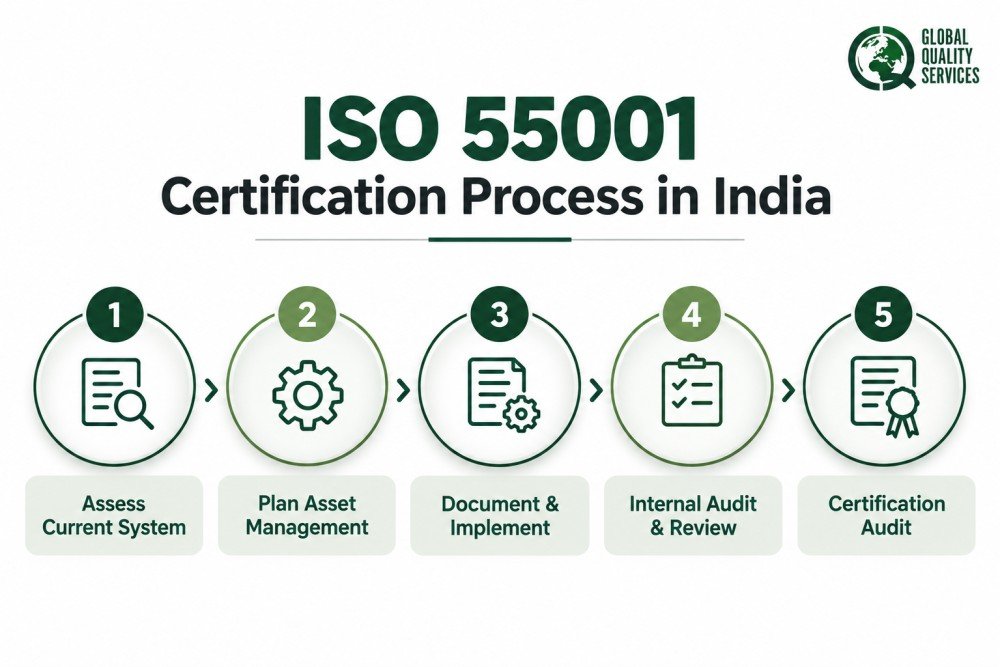
Getting ISO 55001 Certification involves a structured approach that ensures proper planning, system development, and compliance. Here’s how the certification process works step by step.
Step 1: Understand Your Current System
We first look at how your organization currently manages its assets, including maintenance practices, responsibilities, records, and risk controls. This helps identify the areas that need attention before moving ahead with ISO 55001.
Step 2: Plan the Asset Management System
A practical asset management system is then planned around your business needs. The scope, objectives, responsibilities, processes, and asset-related risks are clearly defined.
Step 3: Prepare Documents and Put Them Into Practice
The necessary policies, procedures, plans and records are prepared and introduced into day-to-day operations. Employees are guided on the processes they need to follow and the responsibilities assigned to them.
Step 4: Conduct Internal Audit and Management Review
Once the system is in place, an internal audit is conducted to check whether the requirements are being followed properly. Any gaps are corrected, followed by a management review before the final certification audit.
Step 5: Complete the Certification Audit
A certification body audits the organization to check compliance with ISO 55001 requirements. After successfully addressing any findings raised during the audit, the organization receives its ISO 55001 certification.
Documents Required for ISO 55001 Certification
Passing your audit becomes simple when your paperwork is clean and organized. Our team at Global Quality Services works directly with you to set up every record, ensuring your business stays fully compliant from day one. Here are the primary documents you need for certification:
- Asset Management Policy and Scope
- Strategic Asset Management Plan (SAMP)
- Specific Asset Management Plans
- Updated Asset Register
- Risk Assessment and Preventive Action Records
- Standard Maintenance and Operating Procedures
- Technical Staff Training Logs
- Internal Audit Reports
- Management Review Minutes
- Corrective Action Logs
Summary Points
- ISO 55001 helps organizations manage assets efficiently, improving performance, reliability, and long-term cost control.
- It supports stronger compliance with asset-related regulations and enhances risk prevention across the asset lifecycle.
- Certification boosts transparency, operational consistency, and stakeholder trust, which are critical for infrastructure-heavy and high-investment industries.
- India’s rapid industrial and infrastructure growth makes ISO 55001 a strategic necessity for sustainable, value-driven asset management.
Why Choose Global Quality Services for ISO 55001 Certification?
Global Quality Services, a reputed ISO 55001 consultant, supports organizations with a practical, data-driven approach to ISO 55001 Airport certification. The focus is on building an Energy Management System that aligns with actual energy consumption patterns, operational realities, and regulatory requirements. From energy reviews and baseline development to implementation, internal audits, and certification readiness, Global Quality Services ensures that organizations achieve certification while establishing a system that delivers measurable, sustained energy performance improvements.
GQS Singapore is a member of the Institute of Asset Management UK (Membership ID – 6149246), SCMC Singapore certified management consultant by TUV SUD, Lead auditor in ISO 55001 and has extensive experience in implementing ISO 55001 Asset management system towards successful certification of the standards across different industries such as Airports, Public transport companies, Manufacturing companies, Asset management holding companies, Facility management companies in Singapore, Indonesia, Malaysia, Philippines, Indonesia, Thailand, South Korea, Vietnam.
Partner with Global Quality Services to make your ISO 55001 journey smooth, accurate, and stress-free. Their experts ensure quick compliance and strong results. For more details, contact us today.
ISO 55001 Certification Consultants in India
ISO 55001 Certification in Delhi | ISO 55001 Certification in Bengaluru
ISO 55001 Certification in Noida | ISO 55001 Certification in Hyderabad
ISO 55001 Certification in Ahmedabad | ISO 55001 Certification in Chennai
ISO 55001 Certification in Pune | ISO 55001 Certification in Mumbai
Get Expert Help for ISO 55001 Certification in India
Management of assets should not turn into a complicated process of certification. Global Quality Services is a reputable ISO consulting firm having 26 years of experience in assisting organizations with creating realistic management systems and being well-prepared for certification. We can assist you in gap analysis, documentation, implementation, internal audit, and preparation for ISO 55001 certification. Contact us today and adopt an organized approach towards managing your assets and getting ISO 55001 certified in India.
Frequently Asked Questions
1. Does our company need specific software to implement ISO 55001?
No specific software is required. ISO 55001 focuses on establishing structured management processes and operational discipline. While enterprise asset software can streamline tracking for larger companies, you can successfully implement the standard using your existing systems.
2. Can small businesses apply for ISO 55001 certification?
Yes, businesses of any size can achieve certification. The standard is fully scalable and adapts to your operational size. It allows smaller organizations to organize their physical assets, prevent premature equipment failure, and gain maximum value from limited resources.
3. How does ISO 55001 differ from ISO 9001?
ISO 9001 focuses on general quality management and customer satisfaction, whereas ISO 55001 specifically governs the full lifecycle and financial value of physical assets. Both standards complement each other and share the same structure for easy integration.
4. Will this certification require us to replace our current maintenance team?
Not at all. Certification strengthens your current workforce by giving them structured workflows and reliable data. It optimizes your existing maintenance practices so your team can work more efficiently without replacing anyone.
5. Is it mandatory to certify all our company assets?
No, you have complete control over the scope of your certification. You can choose to certify a single facility, high-risk equipment, or your entire organization. Most companies start with their most critical assets and expand the scope later.