The manufacturing sector in Delhi-NCR is growing fast. Industrial zones such as Okhla, Mayapuri, Noida, and Gurugram are expanding rapidly to serve international markets. According to the latest data from the Press Information Bureau, India reached an all-time high of $860.09 billion in cumulative exports for the 2025-2026 fiscal year. Electronics and engineering goods are leading this push. To maintain this momentum, local factories are stepping up to meet international compliance demands.
Global technology, retail, and automotive brands want to know that their partners maintain safe workplaces, treat staff fairly, and protect the environment. The Responsible Business Alliance standard helps you prove exactly that. Aligning your facility with RBA requirements through professional consulting guidance is the clearest way to establish your business as a preferred supplier for top-tier global buyers.
How Businesses in Delhi Will Benefit from RBA Certification
Preparing your factory for global compliance audits helps protect your local operations while opening doors to better export contracts.
- Win Contracts with International Tech Brands: Major global brands require their supply chains to follow the RBA code. Working with a consultant to prepare your facility makes your company an approved choice for large procurement teams.
- Avoid Local Legal and Regulatory Fines: The framework aligns directly with Indian labor laws, waste management acts, and factory safety rules. Setting up these systems protects your business from sudden closure notices or fines.
- Reduce Costly Staff Turnover: Proper shift scheduling, fair pay structures, and clean working conditions keep your workers happy. This keeps production lines moving and cuts down on hiring costs in competitive hubs like Noida and Gurugram.
- Boost Factory Floor Efficiency: Fixing workplace hazards helps you avoid production shutdowns caused by accidents. Better management of energy and materials also lowers your daily utility bills.
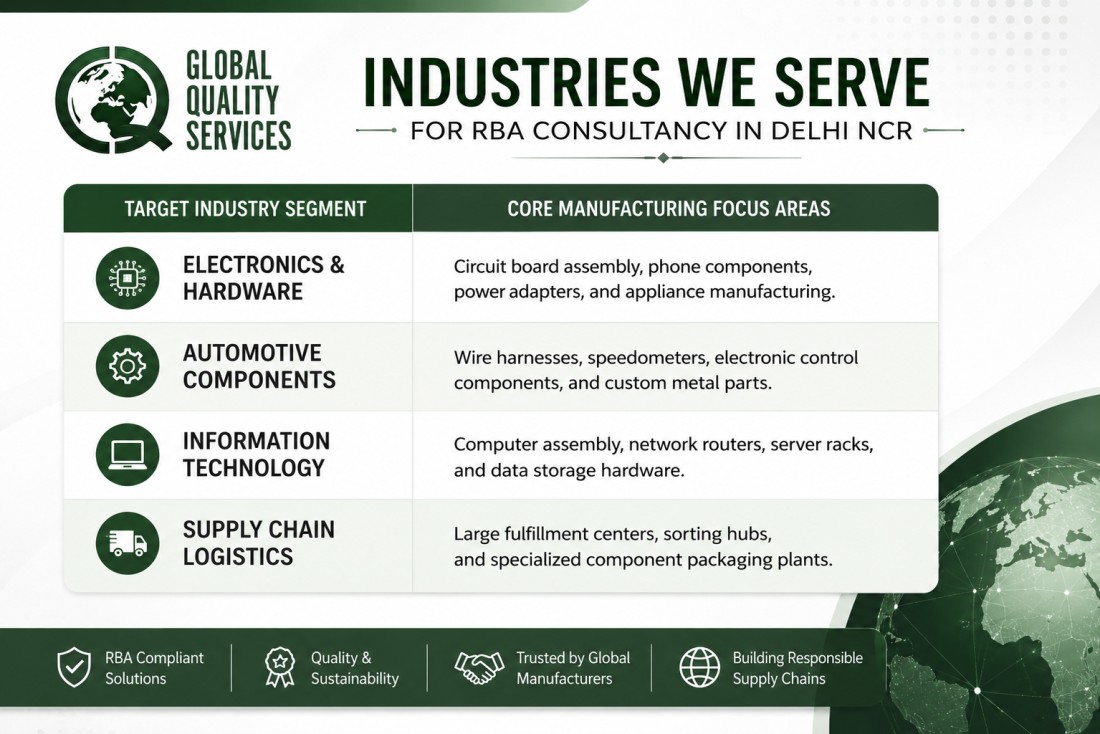
Industries We Serve for RBA Consultancy in Delhi NCR
Any business manufacturing parts for global technology, automotive, or retail supply chains can prepare for this framework.
How Businesses in Delhi Will Benefit from RBA Certification
Preparing your factory for global compliance audits helps protect your local operations while opening doors to better export contracts.
- Win Contracts with International Tech Brands: Major global brands require their supply chains to follow the RBA code. Working with a consultant to prepare your facility makes your company an approved choice for large procurement teams.
- Avoid Local Legal and Regulatory Fines: The framework aligns directly with Indian labor laws, waste management acts, and factory safety rules. Setting up these systems protects your business from sudden closure notices or fines.
- Reduce Costly Staff Turnover: Proper shift scheduling, fair pay structures, and clean working conditions keep your workers happy. This keeps production lines moving and cuts down on hiring costs in competitive hubs like Noida and Gurugram.
- Boost Factory Floor Efficiency: Fixing workplace hazards helps you avoid production shutdowns caused by accidents. Better management of energy and materials also lowers your daily utility bills.
Is RBA a Certification or an Assessment?
The Responsible Business Alliance framework is primarily an assessment, not a traditional certification. It evaluates a facility’s compliance with the RBA Code of Conduct through a structured, on-site process.
Instead of issuing a formal, permanent wall certificate, the independent third-party audit body generates an official audit report and a performance score. Organizations use this output to verify compliance, identify operational risks, and track improvements over time.
To recognize high-performing factories, the RBA awards formal Recognition Tiers directly based on the final audit score and the successful closure of critical issues:
- Platinum Recognition: Awarded to facilities achieving a minimum score of 200 points with all priority findings closed.
- Gold Recognition: Awarded to facilities achieving a minimum score of 180 points with all priority findings closed.
- Silver Recognition: Awarded to facilities achieving a minimum score of 160 points with all priority findings closed.
Our Step-by-Step RBA Implementation Process
Getting a high score requires steady preparation before the official external reviewers arrive. We break down our consulting support into clear operational phases to facilitate a smooth audit process.
Step 1: Initial Gap Analysis and Record Review
We look over your current factory policies, employment contracts, safety logs, and environmental waste certificates to spot any gaps compared to the official code.
Step 2: Policy Updates and Management Systems Setup
We help you update your operational documents by setting up clear anti-discrimination policies, worker complaint channels, and emergency plan diagrams for your floor layout.
Step 3: Workplace Adjustments and Employee Training
We run simple, practical training sessions for your HR staff, floor supervisors, and workers covering overtime tracking, personal protective equipment rules, and chemical safety steps.
Step 4: Internal Pre-Assessment Simulation
Our team carries out a complete practice audit using the exact scoring guidelines of an official VAP review to catch any remaining errors early.
Step 5: Corrective Actions and Final Adjustments
We guide you in fixing any issues found during the practice run, such as updating chemical storage areas, refining safety signs, or cleaning up hours logs to maximize your score.
Step 6: Official Third-Party VAP Audit Support
We stand by your team and provide ongoing support during the formal audit day to make sure all documentation, data sheets, and staff interviews go smoothly to secure your target score from the independent auditors.
Common Challenges in Achieving RBA Compliance
During factory reviews, specific operational issues often lead to point deductions if they are not managed properly before the independent auditors arrive.
- Managing Overtime and Working Hours: The code sets a firm limit of 60 hours per week, including overtime, and requires at least one full day of rest every seven days. Staying within these bounds during busy production seasons requires smart scheduling.
- Hidden Recruitment Fees: Workers cannot be forced to pay fees to secure a job. If your third-party security or cleaning agencies charge workers processing fees, your company can face penalties during the audit.
- Weak Complaint Systems: A drop-box or complaint line must be completely anonymous and confidential. Workers must feel secure using it without any fear of facing negative consequences from supervisors.
- Chemical Handling Flaws: Auditors check your chemical areas closely. Missing safety sheets, unlabelled containers, or a lack of secondary containment trays to catch leaks will result in score deductions.
Why Choose Global Quality Services for RBA Consultancy in Delhi?
Preparing your factory for international compliance does not have to be complicated. As a professional consultancy firm, we focus entirely on being your practical preparation partner. We are not a direct certification body or auditing agency, meaning our sole priority is getting your facility ready for independent review.
- Localized NCR Expertise: We understand the exact operational realities of manufacturing hubs across Delhi, Noida, and Gurugram.
- On-Floor Implementation: Our consultants work directly with your HR and factory floor teams to resolve operational gaps instead of just giving you paperwork templates.
- End-to-End Facilitation: We guide you through everything from the first gap analysis and worker training to final pre-audit simulations.
- Score Optimization: We target and fix common penalty risks like shift scheduling and chemical storage to help you secure top recognition tiers.
Secure Your Global Supply Chain Standing
An authoritative RBA assessment score is your most powerful asset for securing high-value international manufacturing contracts. Let us help you upgrade your workplace practices, protect your operational margins, and qualify for elite supplier status with global enterprise brands.
- Open Global Markets: Instantly clear compliance barriers for major technology, automotive, and retail procurement networks.
- Protect Your Operations: Avoid costly local regulatory fines and production shutdowns through airtight labor and environmental management systems.
- Lower Operational Costs: Reduce factory worker turnover and optimize floor resource efficiency to protect your baseline margins.
- Maximize Your Score: Eliminate costly audit pitfalls early with our practical, hands-on mock simulation reviews.
Ready to eliminate trade barriers and scale your manufacturing business? Partner with Global Quality Services to build an efficient, compliant, and globally competitive production facility.
Frequently Asked Questions
1. What are the five main areas covered by the RBA Code of Conduct?
The standard evaluates five core operational areas: Labor practices, Health and Safety, Environmental management, Business Ethics, and Management Systems.
2. How long does an official RBA audit score remain valid?
The final assessment report is valid for two years from the closing date of the initial review, provided no major violations occur.
3. Is Global Quality Services a direct certification agency for the RBA?
No, we are an independent consultancy firm. We facilitate the preparation process, while the official audits and score tiers are issued by independent, RBA-approved third-party bodies.
4. How do we know if our factory is ready for a formal RBA review?
Your facility is ready if you can show three to six months of organized records, including matching timecards, payroll summaries, and active safety committee logs.
5. Can a factory lose its recognition tier ranking before the two years are up?
Yes, a factory can lose its ranking if verified reports confirm critical violations like severe safety hazards, child labor issues, or illegal waste dumping.