PCQI FSMA Certification in India
According to official figures released by the Ministry of Commerce and Industry, India’s agricultural and processed food exports reached an all-time high of USD 52.55 billion in FY 2025-26. The United States remains one of the largest destination markets for Indian food products, including spices, tea, processed foods, and marine items. However, tapping into the lucrative American food market requires strict compliance with international food safety laws enforced by the United States Food and Drug Administration.
Under 21 CFR Part 117 of the Food Safety Modernization Act, every foreign facility exporting food products to the US must establish a risk-based Food Safety Plan. This plan must be developed, implemented, and overseen by a certified Preventive Controls Qualified Individual. Achieving formal qualification ensures your processing facility maintains seamless trade access, avoids port detentions, and builds trust with international buyers.
What is PCQI FSMA Certification in India
PCQI FSMA Certification in India is a formal certification that certifies that the person who is working in food safety has received training from the FDA of the United States through the FSPCA Curriculum. While traditional quality management training includes the general concepts of quality management, the certification involves special regulations about how the food will be exported to the US.
The certified individual creates and implements the complete plan for food safety that includes hazard analysis, process control, allergens, and sanitation.
Many Indian facilities already hold FSSC 22000 certification under the Global Food Safety Initiative framework. Though FSSC 22000 provides an excellent framework through HACCP guidelines, incorporating PCQI training provides an easy transition from these international quality standards to the US statutory requirements.
Why Businesses in India Need PCQI Certification for US Food Exports
Food exports from India to the USA demand rigorous compliance testing before export. Any non-compliance may result in import warnings, product rejection, and heavy losses. Having a PCQI will help you ensure that your manufacturing system meets all foreign inspection standards:
- Mandatory US Regulatory Compliance: United States federal law mandates that foreign food facilities must have a qualified individual oversee their written Food Safety Plan.
- Reduction of Port Detentions: Properly validated preventive control plans significantly lower the risk of cargo holds and rejections by border authorities.
- Increased Importer Confidence: American buyers prefer partnering with Indian manufacturers who proactively maintain certified quality personnel.
- Expanded Protection Beyond HACCP: Preventive controls cover supply chain hazards, sanitation controls, and allergen management beyond standard control points.
Industries in India That Commonly Require PCQI Certification
Businesses involved in processing, packaging, storage, or manufacturing food products for the United States often require trained personnel who understand FDA preventive controls. Common industries include:
- Spice manufacturers and exporters
- Dairy processing companies
- Seafood processing units
- Ready-to-eat food manufacturers
- Frozen food manufacturers
- Beverage manufacturers
- Bakery and confectionery companies
- Grain and cereal processors
- Edible oil manufacturers
- Nutraceutical and dietary supplement manufacturers
- Fruit and vegetable processing companies
- Contract food manufacturers
- Food ingredient suppliers
- Snack food manufacturers
- Packaging facilities serving food exporters
Our PCQI Certification Approach for Businesses in India
Our practical training process simplifies regulatory requirements into structured learning phases. This approach ensures participants build real-world implementation skills tailored to Indian processing environments.
Step 1: Initial Compliance & Organizational Gap Review
We assess your current operational practices and evaluate existing certifications like FSSC 22000 or ISO 22000 to identify specific compliance gaps relative to US export laws.
Step 2: FSPCA Standardized Interactive Training
Participants go through the official Food Safety Preventive Controls Alliance curriculum led by accredited instructors. The sessions cover biological, chemical, physical, and economically motivated hazards.
Step 3: Hands-On Food Safety Plan Development
Candidates work through practical exercises to draft a functional Food Safety Plan. Exercises focus on hazard evaluation, process controls, allergen controls, sanitation practices, and supply chain verification.
Step 4: Participant Evaluation & Plan Verification
Instructors evaluate participant comprehension through class exercises, plan reviews, and scenario assessments to ensure practical competency.
Step 5: Official AFDO Certificate Issuance
Upon completing the full course hours, participants receive their official certificate issued directly by the Association of Food and Drug Officials and recognized worldwide.
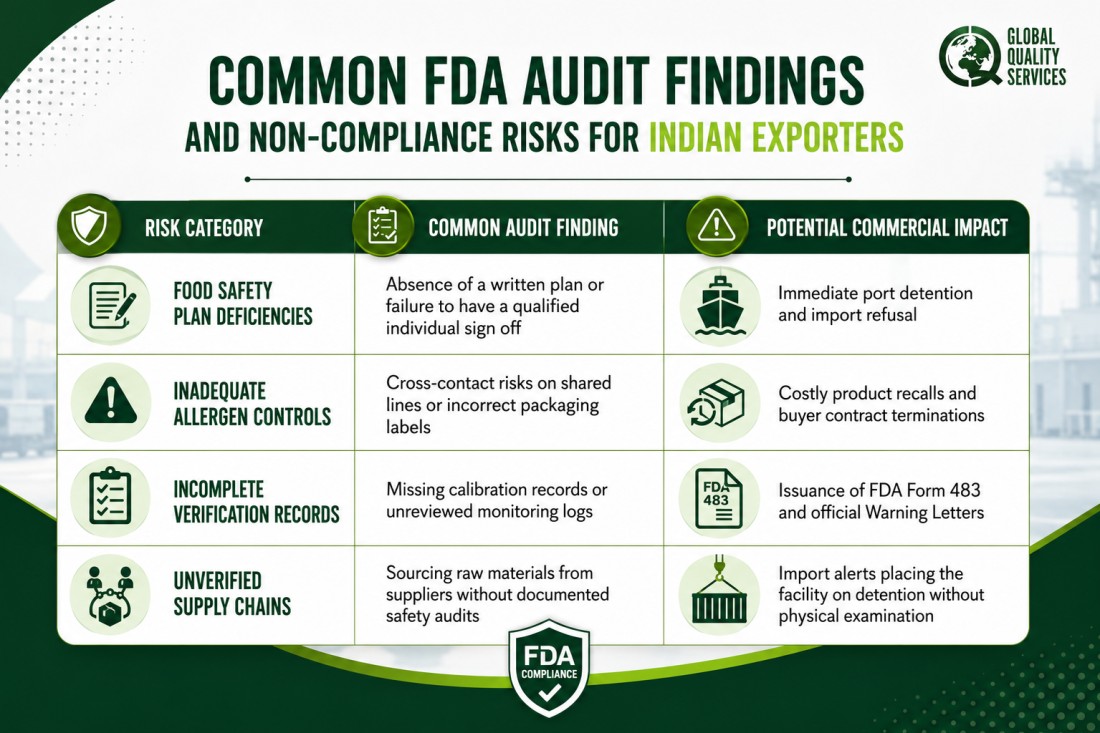
Common FDA Audit Findings and Non-Compliance Risks for Indian Exporters
Understanding where foreign processing facilities frequently fail regulatory audits helps organizations proactively correct vulnerabilities before goods leave Indian ports.
How Global Quality Services Supports PCQI Certification Across India
Choosing the right training partner helps your business meet FDA requirements with confidence. At Global Quality Services, we provide practical PCQI training and compliance support that helps food businesses strengthen their food safety systems and prepare for US exports. Our Support Includes:
- FDA-recognized PCQI training based on the FSPCA curriculum
- Practical guidance for Food Safety Plan development
- Industry-specific training for different food sectors
- Assistance with preventive controls and compliance documentation
- Flexible training options for businesses across India
Ready to Meet FSMA Requirements with PCQI Certification?
Joining the US food market is an important milestone, and getting your food safety systems right is critical here. The PCQI Certification can help you establish the right framework for your FSMA compliance, successfully meet your buyers’ demands, be well prepared for inspections, and ensure food safety. This is not only compliance, but an expression of your commitment to manufacturing safe and high-quality foods that can be trusted by international customers.
If you are just beginning your exports, or wish to enhance your food safety system, then the time has come. Global Quality Services is devoted to assisting Indian businesses in getting their PCQI Certification right and providing the necessary advice. Contact us now and move towards your goal with confidence.
Frequently Asked Questions
1. What credentials qualify a person as a qualified individual according to US laws?
An individual qualifies by undertaking training on risk-based preventive control from an approved course curriculum approved by the United States Food and Drug Administration, or equivalent job experience in creating food safety systems.
2. Should there be a different qualified individual for each product line at a particular facility?
No, there shouldn’t be. The trained individual can create and manage the Food Safety Plans for more than one product line in a facility, as long as he or she has the technical expertise for each product.
3. How are preventive control rules for economic hazards dealt with?
Facilities are supposed to assess any chemical hazards that might be brought into a food facility for the sake of economic benefit, like unauthorized colors or adulterated ingredients, and put in place verification measures.
4. Does Food Safety Plan reanalysis have a set schedule?
The reanalysis of the Food Safety Plan is to be done at least once every three years. It should also be done when there is any new process change or contamination problems.
5. Are virtual classes able to provide an equivalent certificate as in-class trainings?
Yes. Live virtual training classes conducted by a certified Lead Instructor, using approved curriculum, will qualify individuals to receive the same certificate provided by the Association of Food and Drug Officials.