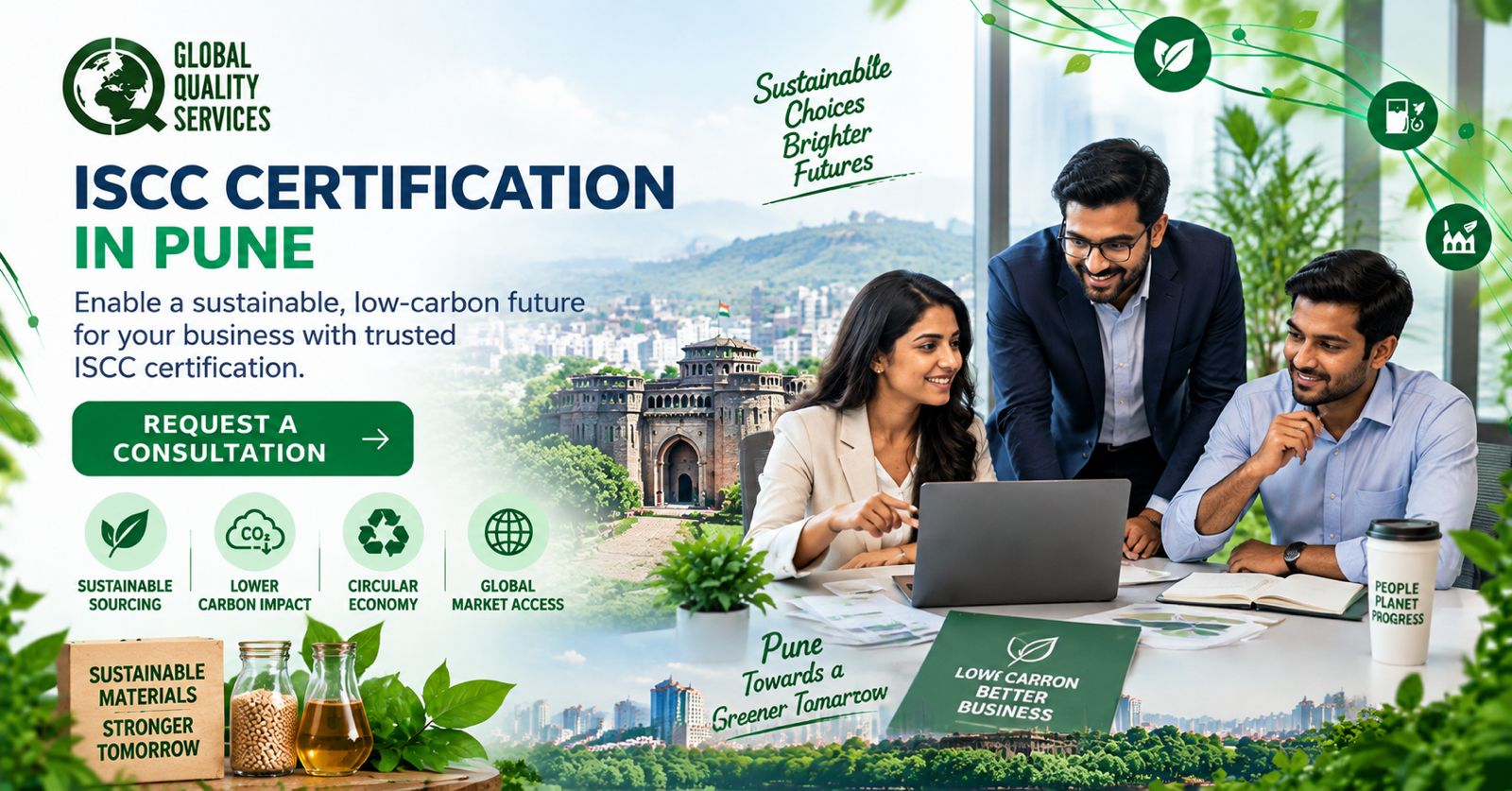
Pune’s manufacturing economy spans automotive and auto components, engineering, electronics, pharmaceuticals, chemicals, plastics, packaging, and technology-driven industries. As these sectors increasingly work with recycled, renewable, bio-based, or other alternative feedstocks, companies may need stronger evidence of where materials originate and how sustainability claims are maintained throughout the supply chain.
ISCC Certification in Pune provides a recognized framework for demonstrating sustainability, traceability, and controlled handling of eligible materials.
The appropriate ISCC scheme depends on the company’s products, feedstocks, supply chain, and target market. ISCC EU addresses specific EU regulatory markets, while ISCC PLUS is designed for circular and bio-based products and other global applications. Other ISCC schemes cover areas including sustainable aviation fuel and product carbon footprint certification.
Global Quality Services (GQS) supports Pune organizations with ISCC consultancy and certification-readiness activities, including scope identification, supply-chain mapping, documentation, traceability controls, mass balance preparation, and audit readiness. The formal certification audit is conducted by an applicable ISCC cooperating Certification Body.
Why Is ISCC Certification Relevant to Pune’s Manufacturing Sector?
ISCC can help Pune manufacturers demonstrate that eligible sustainable or alternative materials are controlled and traceable from their source through relevant stages of the supply chain.
This is particularly relevant to Pune because the region has a substantial automotive and engineering base alongside electronics, pharmaceuticals, chemicals, and other manufacturing activities. MIDC identifies automobiles, chemicals, electronics and pharmaceuticals among Maharashtra’s focus sectors.
For manufacturers supplying global OEMs and other international customers, sustainability requirements can extend beyond the finished product. Customers may also want evidence about the origin of selected materials, recycled content, renewable feedstocks, or the controls used to support sustainability claims.
ISCC can provide a structured way to manage this information.
Which Companies in Pune Can Consider ISCC Certification?
ISCC may be relevant to organizations whose products or supply chains involve eligible sustainable, renewable, recycled, or alternative feedstocks.
The certification is therefore not limited to companies producing biofuels. Depending on the applicable scheme, potential users can include:
Automotive and Auto Component Manufacturers
Pune has a major automotive manufacturing ecosystem, with Pimpri-Chinchwad alone containing thousands of manufacturing and supporting industrial units according to MIDC.
Companies in this supply chain that use or process eligible alternative materials may need documented controls over material sourcing, processing, inventory, and sustainability claims.
Plastics and Polymer Manufacturers
Manufacturers using recycled or bio-based polymer feedstocks may consider ISCC PLUS where the scheme’s requirements match their products and target market.
ISCC PLUS supports the tracking of alternative feedstocks using physical segregation, controlled blending, and mass balance approaches.
Chemical and Specialty Material Companies
Chemical manufacturers can use ISCC-related controls to establish greater transparency around eligible alternative feedstocks and the movement of certified materials through production.
Electronics and ESDM Companies
Pune’s Talegaon and Khed areas are identified by MIDC as established electronics system design and manufacturing hubs.
Organizations within this ecosystem may encounter customer requirements concerning sustainable materials, responsible sourcing, and documented supply-chain information.
Pharmaceutical and Life Sciences Companies
Pune has a significant pharmaceutical and biotechnology presence, including the Serum Bio-Pharma Park identified by MIDC.
ISCC applicability depends on the actual materials and supply-chain activities involved rather than the industry name alone.
Packaging and Converting Companies
Packaging manufacturers working with recycled, renewable, or bio-based inputs may need documented evidence supporting material claims made to downstream customers.
Recycling and Circular Economy Businesses
Organizations processing eligible waste-derived or recycled feedstocks may have a direct interest in chain-of-custody systems that provide traceability through the supply chain.
What Does ISCC Certification Actually Verify?
ISCC certification focuses on defined sustainability and traceability requirements applicable to the selected scheme, rather than simply verifying that a company describes its products as sustainable.
Depending on the scheme and scope, preparation may involve:
- Sustainable feedstock sourcing
- Supplier and origin documentation
- Material traceability
- Chain-of-custody controls
- Mass balance calculations
- Physical segregation
- Controlled blending where applicable
- Transaction and inventory records
- Sustainability declarations
- Greenhouse gas-related information where applicable
- Management responsibilities
- Internal controls and records
For ISCC PLUS, alternative feedstocks can be tracked using different chain-of-custody methods, including mass balance, physical segregation, and controlled blending.
What Needs to Change Inside a Pune Organization Before Certification?
The organization needs to be able to connect its sustainability information with actual purchasing, storage, production, inventory, and sales records.
For example, a manufacturer purchasing recycled feedstock should be able to demonstrate:
Supplier → Incoming Material → Storage → Production → Inventory → Finished Product → Customer
The records supporting each stage need to be consistent.
Purchasing Controls
Procurement teams should know what documentation is required from suppliers and how the organization verifies relevant sustainability information.
Warehouse Controls
Stores and inventory teams may need clear identification and segregation controls depending on the selected chain-of-custody method.
Production Controls
Production records should allow relevant certified or eligible materials to be connected with the resulting output.
Sales Documentation
Sales documents and sustainability claims should correspond with the organization’s certified scope and available evidence.
Mass Balance Accounting
Where mass balance is used, the organization needs a reliable system for recording relevant inputs, outputs, conversions, allocations, and stock balances.
ISCC states that its mass balance requirements are documented in the applicable chain-of-custody system documents, including specific requirements for ISCC EU and ISCC PLUS.
How Does the ISCC Certification Process Work in Pune?
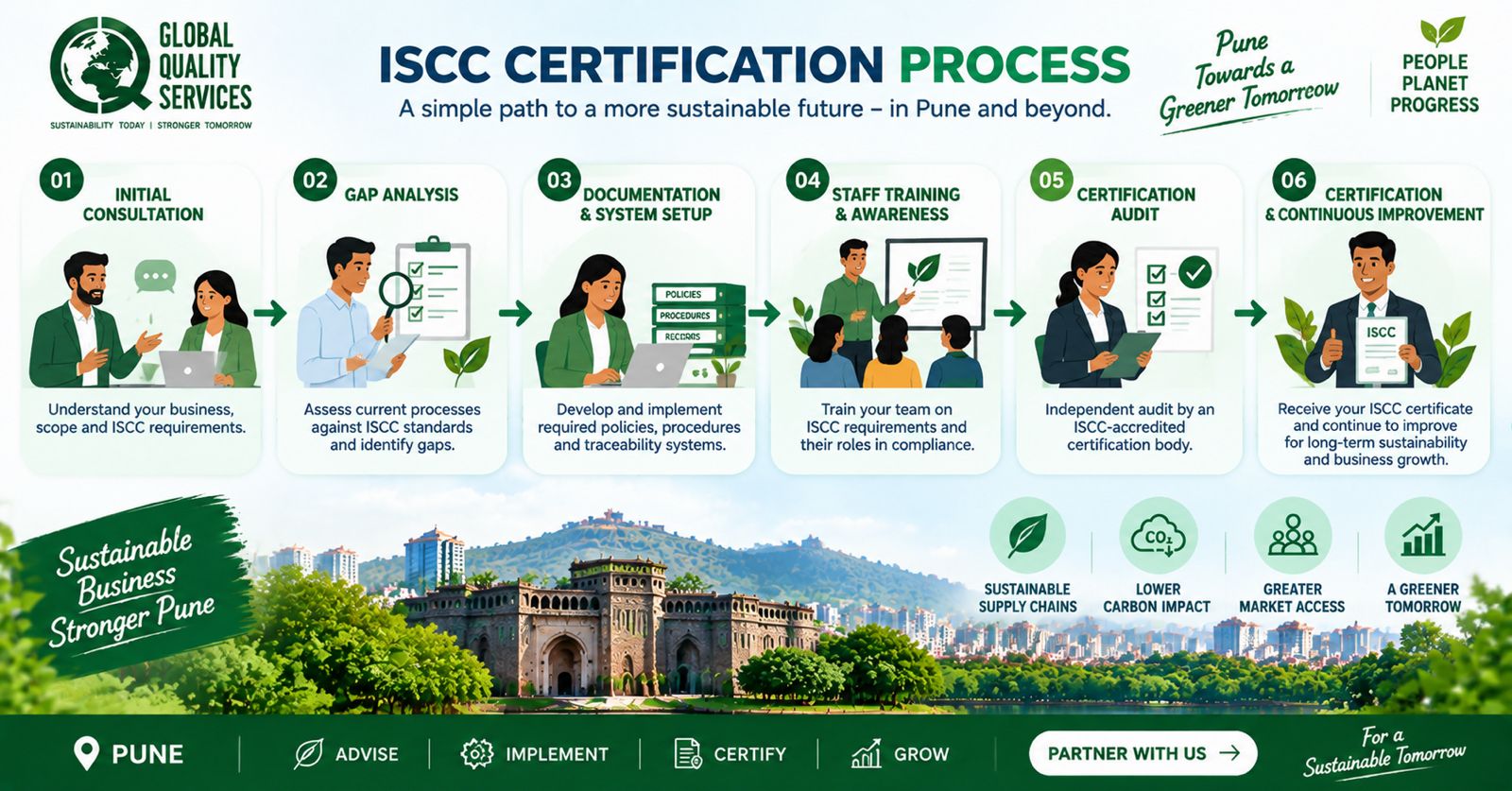
The certification process starts by identifying the applicable scheme and scope, followed by implementation of the required controls and an independent audit.
1. Determine the Applicable Scheme
Identify whether the business needs ISCC EU, ISCC PLUS, ISCC CORSIA, or another applicable scheme.
2. Establish the Scope
Define the facility, activities, products, feedstocks, suppliers, storage arrangements, and relevant supply-chain activities.
3. Map the Material Flow
Document how eligible materials enter the organization, where they are stored, how they are processed, and where the resulting products go.
4. Review Existing Systems
Assess supplier records, purchase documents, inventory systems, production records, transaction records, sustainability declarations, and existing procedures.
5. Establish Missing Controls
Develop or strengthen procedures for traceability, chain of custody, mass balance, material identification, supplier management, and claim control as applicable.
6. Conduct a Readiness Review
GQS can review the available evidence and identify gaps before the formal audit.
7. Complete the Independent Certification Audit
The organization then works with an ISCC cooperating Certification Body for the formal audit and certification activity. ISCC maintains a list of cooperating Certification Bodies that are authorized to conduct audits and certification activities within their approved scopes.
Why Can ISCC Be Valuable for Pune’s Automotive Supply Chain?
ISCC can give eligible automotive and component suppliers a structured way to document alternative-material flows when sustainability requirements extend into the manufacturing supply chain.
Pune’s automotive ecosystem includes vehicle manufacturers, component manufacturers, engineering companies, tooling operations, material suppliers, and other supporting businesses. MIDC describes Pune as a major automotive manufacturing center and identifies a large concentration of manufacturing and ancillary units in Pimpri-Chinchwad.
For companies supplying international customers, the ability to document the origin and movement of eligible materials can become part of broader customer and supply-chain requirements.
This can be particularly relevant where manufacturers introduce recycled polymers, bio-based materials, renewable inputs, or other alternative feedstocks into existing production processes.
How Can ISCC Support Pune’s Electronics and ESDM Ecosystem?
ISCC can support electronics-related organizations when eligible alternative materials and sustainability claims form part of their supply-chain requirements.
MIDC identifies Talegaon and Khed in Pune district as established ESDM hubs and notes the development of an electronic manufacturing cluster in Pune.
For these businesses, certification preparation may involve reviewing suppliers, material specifications, purchasing records, production processes, inventory controls, and customer-facing sustainability information.
ISCC should not be treated as a generic electronics certification. Its relevance depends on the actual materials and supply-chain activities covered by the applicable scheme.
What Are the Benefits of ISCC Certification for Pune Organizations?
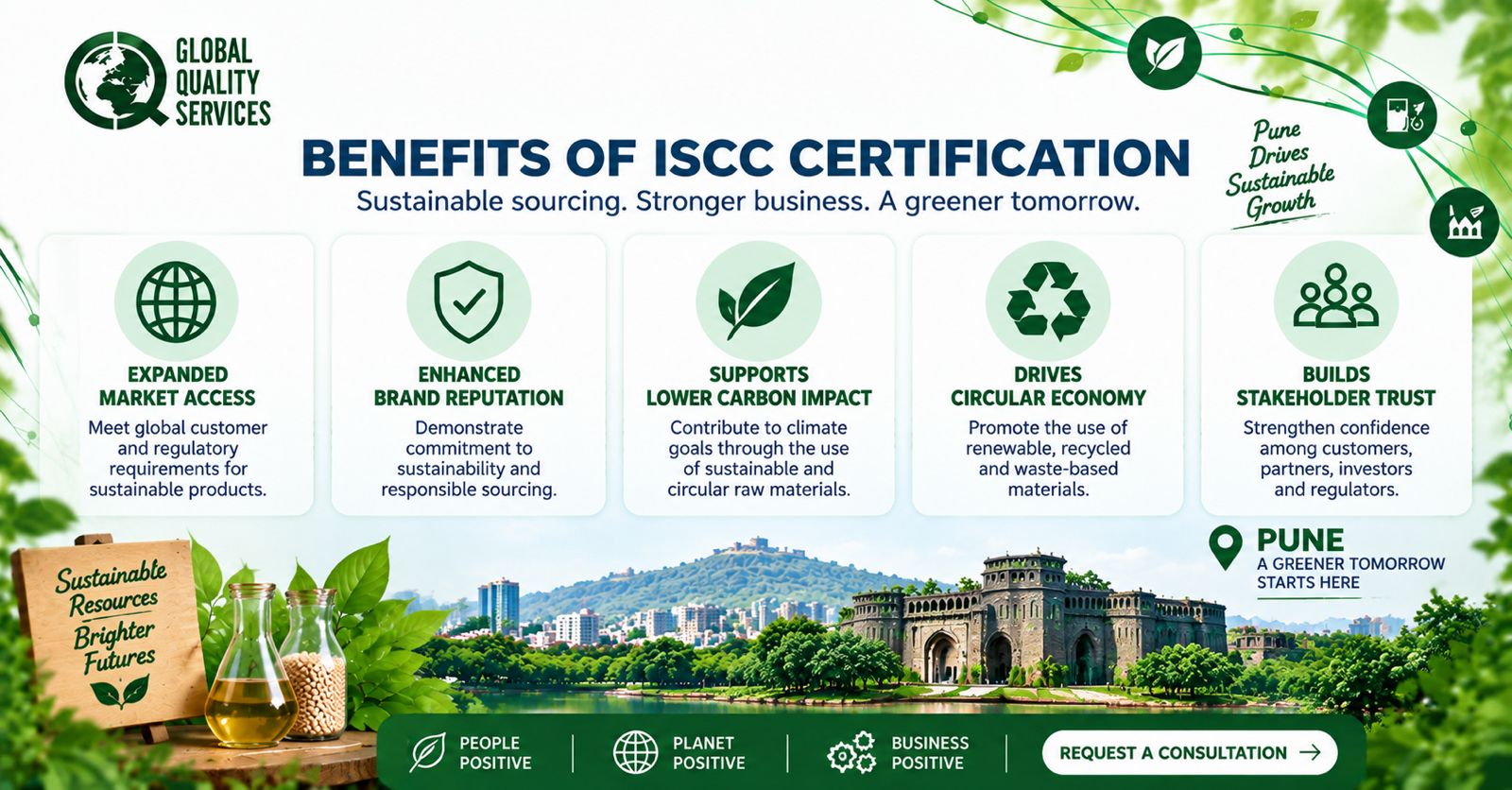
ISCC can strengthen the evidence behind sustainability-related material claims while improving visibility across relevant supply-chain processes.
Demonstrate Verified Sustainability Characteristics
Organizations can use certification to demonstrate applicable sustainability characteristics through an independently audited system.
Improve Material Traceability
Documented chain-of-custody controls help organizations track relevant materials through defined supply-chain stages.
Support Circular Material Use
ISCC PLUS can help companies working with alternative feedstocks participate in circular and bio-based supply chains.
Respond to Customer Requirements
Certification may help organizations address procurement requirements from customers seeking independently verified sustainability information.
Strengthen Internal Material Accounting
Defined records can improve the organization’s ability to reconcile incoming materials, production outputs, inventory, and relevant certified transactions.
Prepare for International Supply Chains
A structured certification framework can help Pune manufacturers working with international customers organize sustainability evidence in a consistent manner.
Areas We Serve for ISCC Certification in Pune
GQS supports organizations across Pune’s major industrial and commercial corridors, including:
- Pimpri-Chinchwad: Automotive, engineering, component manufacturing, plastics, and industrial supply chains.
- Bhosari: Engineering, fabrication, automotive components, chemicals, and manufacturing.
- Chakan: Automotive, auto components, logistics, engineering, and large manufacturing facilities.
- Talegaon: Automotive, electronics, engineering, and industrial manufacturing.
- Khed: ESDM, electronics, manufacturing, and industrial operations.
- Ranjangaon: Electronics, engineering, automotive, and manufacturing activities.
- Hinjawadi: Technology and businesses connected with advanced manufacturing and global supply chains.
- Hadapsar: Manufacturing, technology, commercial, and industrial support operations.
- Kurkumbh and the wider Pune region: Chemical and industrial operations within Maharashtra’s broader manufacturing network.
MIDC identifies Pune’s automotive and electronics ecosystems as important industrial clusters, while Maharashtra’s wider industrial strategy includes chemicals and pharmaceuticals among its major sectors.
How Can Global Quality Services Help With ISCC Certification in Pune?
Global Quality Services helps Pune organizations prepare their systems, documentation, and evidence before the independent ISCC certification audit.
GQS focuses on making ISCC requirements workable within the organization’s existing operations instead of treating certification as a collection of standalone documents.
For a Pune manufacturer, this means looking at how materials are actually purchased, received, stored, transformed, transferred, and sold.
The approach can be particularly useful for organizations operating complex supply chains where procurement, stores, production, quality, sustainability, finance, and sales all hold different pieces of the information needed to demonstrate traceability.
GQS can help bring those controls together into a structured certification-readiness system.
Begin ISCC Certification Preparation in Pune
The best starting point is to identify your target market, material inputs, products, and intended sustainability claims before developing ISCC documentation.
A preliminary review can establish whether ISCC EU, ISCC PLUS, ISCC CORSIA, or another scheme is relevant to the organization. It can also identify the appropriate chain-of-custody approach and the evidence that will need to be maintained.
FAQs About ISCC Certification in Pune
Is ISCC Certification mandatory for Pune manufacturers?
ISCC is not automatically mandatory for every manufacturer. Its relevance depends on the applicable market, regulatory requirements, customer expectations, products, feedstocks, and supply-chain role.
Is ISCC PLUS suitable for recycled plastic manufacturers in Pune?
It can be relevant where the organization works with eligible alternative feedstocks and serves markets covered by ISCC PLUS. The company must determine the applicable scope and chain-of-custody approach based on its actual operations.
Can automotive companies in Pune obtain ISCC Certification?
Potentially, yes. Industry classification alone does not determine eligibility. An automotive or component manufacturer should assess its specific materials, suppliers, production processes, customer requirements, and target market.
Does GQS conduct the official ISCC certification audit?
GQS provides consultancy and certification-readiness support. The formal audit and certification activity is conducted by an applicable ISCC cooperating Certification Body within its approved scope.
How can a company start ISCC Certification in Pune?
Begin by identifying the materials involved, their sources, the products manufactured, the target markets, and the sustainability claims the organization needs to support. These details can then be used to determine the appropriate ISCC scheme and certification scope.