Delhi is home to a large and diverse business ecosystem that includes software companies, fintech businesses, e-commerce platforms, IT service providers, digital businesses, and technology-driven enterprises. As organizations increasingly develop applications and platforms that support online transactions, payment processing, and digital commerce, software security has become a key business consideration.
PCI Software Security Framework Certification in Delhi can help eligible software organizations establish structured security practices for software used in payment-related environments. Global Quality Services supports organizations with PCI SSF requirement review, gap assessment, documentation, remediation guidance, and assessment preparation.
Why Is PCI SSF Important for Software Companies in Delhi?
Delhi’s business environment includes organizations developing software for financial services, retail, e-commerce, hospitality, transportation, digital services, and other sectors where payment functionality is increasingly integrated into applications.
For software vendors and developers, security requirements may also come from customers, business partners, payment-related organizations, or contractual arrangements.
PCI SSF can help eligible organizations strengthen their software security approach and meet applicable customer and business requirements.
- Strengthens secure software development practices
- Helps identify and address software vulnerabilities
- Improves security testing and verification
- Supports structured vulnerability management
- Encourages security throughout the software lifecycle
- Helps address customer security expectations
- Provides documented evidence of security practices
- Supports payment-related software security requirements
- Builds greater confidence in software products
Which Organizations in Delhi Should Consider PCI SSF?
Organizations should evaluate PCI SSF applicability based on their software’s nature and function and whether it operates within or supports a payment environment.
Fintech Companies
Fintech businesses developing digital payment applications, financial platforms, wallets, transaction systems, lending applications, and related technologies may need to evaluate PCI SSF requirements. Secure software development is particularly important where applications support payment-related functions.
Payment Application Developers
Companies developing payment applications need to consider security throughout software design, coding, testing, deployment, and maintenance. PCI SSF can provide a structured basis for evaluating applicable software security practices.
SaaS Providers
SaaS companies providing billing, subscription management, merchant services, payment integrations, or other payment-related functionality may need to assess whether their software falls within an applicable PCI SSF program.
E-Commerce Technology Providers
E-commerce platforms often integrate shopping, checkout, payment gateways, customer accounts, and transaction systems. Developers of these technologies should evaluate PCI SSF applicability where their software supports payment-related activities.
Digital Payment Solution Providers
Organizations developing payment gateways, transaction platforms, digital wallets, mobile payment applications, or supporting technologies may need to demonstrate appropriate software security practices.
IT and Software Service Providers
Delhi has a large technology services ecosystem. IT companies developing, customizing, or maintaining software for payment-related customers should evaluate whether PCI SSF requirements apply to the software they provide.
Mobile and Web Application Developers
Mobile and web applications increasingly support purchases, subscriptions, bookings, and digital payments. Developers should evaluate PCI SSF applicability when their applications perform or facilitate payment-related functions.
Banking and Financial Technology Providers
Technology companies supplying software to banks, financial institutions, payment providers, and other financial organizations may face specific customer security requirements. PCI SSF can be relevant where the software falls within an applicable PCI SSC program.
Retail Technology Providers
Companies developing point-of-sale applications, merchant platforms, billing software, payment integrations, and retail transaction systems may need to evaluate PCI SSF requirements.
Hospitality and Travel Technology Companies
Booking platforms, hotel management systems, travel applications, and hospitality technology frequently include payment functionality. Software providers in this sector should consider applicable PCI SSF requirements where their applications support payment transactions.
Areas We Cover for PCI DSS Certification in Delhi
PCI Software Security Framework certification support is available across Delhi’s major technology, commercial, industrial, and business locations.
- Connaught Place
- Nehru Place
- Okhla
- Jasola
- Saket
- Aerocity
- Bhikaji Cama Place
- Netaji Subhash Place
- Mayur Vihar
- Patparganj
- Rohini
- Dwarka
- Rajouri Garden
- Naraina
- Wazirpur
- Kirti Nagar
- Other business and technology locations across Delhi NCR
What Does PCI Software Security Framework Assessment Cover?
PCI SSF assessment preparation involves reviewing the organization’s software and the processes used to develop, test, release, and maintain it.
Secure Software Development
Organizations need appropriate practices for incorporating security into relevant stages of the software development lifecycle, from design and development through testing and maintenance.
Vulnerability Management
Processes for identifying, evaluating, tracking, and addressing software vulnerabilities are an important part of maintaining secure software.
Security Testing
Appropriate security testing and verification should be incorporated into the development process, with evidence maintained to demonstrate that applicable requirements are being addressed.
Access and Change Management
Organizations may need controls governing access to source code, development environments, software releases, and other relevant systems and assets.
Documentation and Evidence
Policies, procedures, testing records, vulnerability information, development records, and other supporting evidence may be required to demonstrate that applicable security practices are implemented.
PCI Software Security Framework Certification Process in Delhi
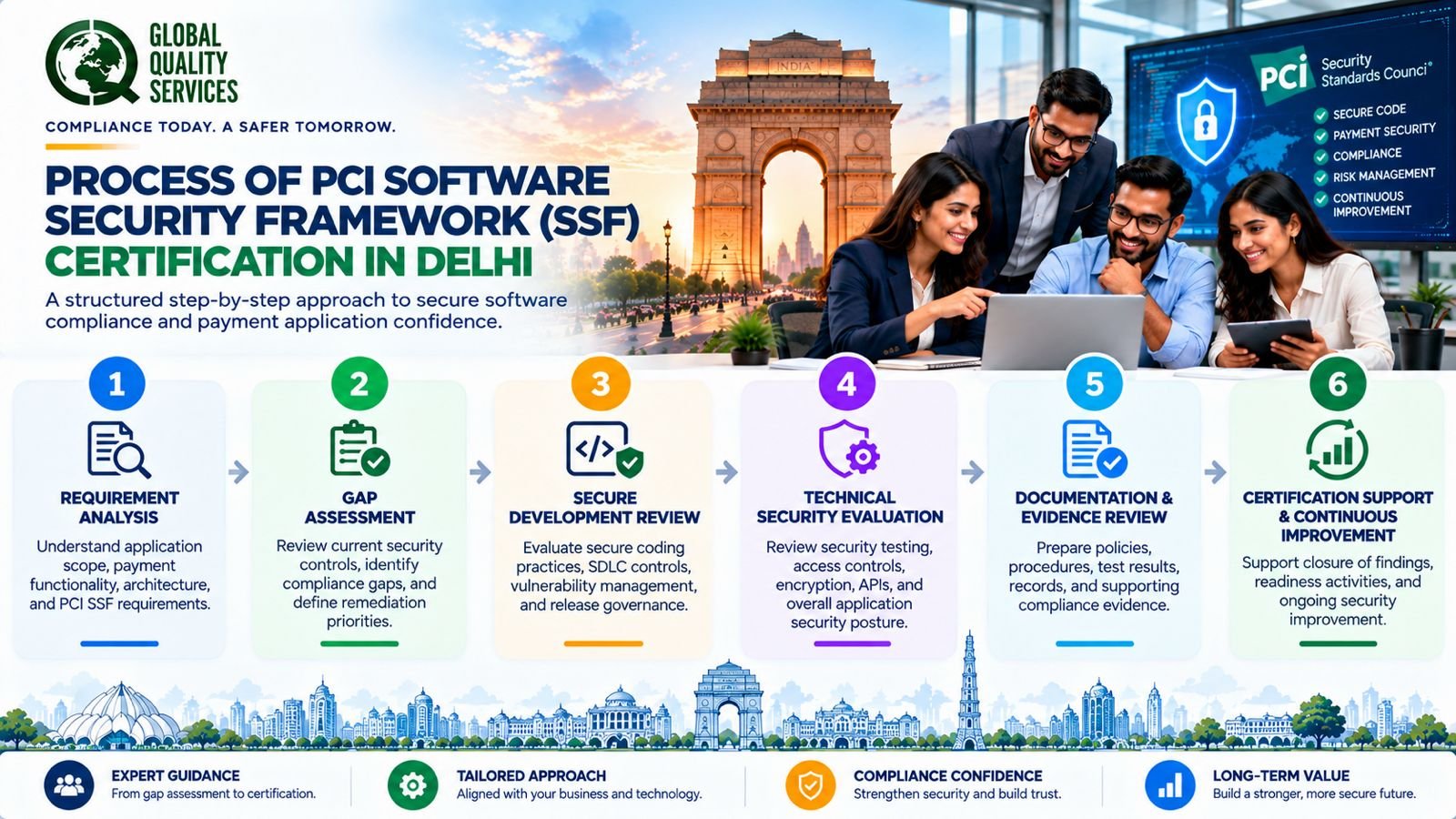
1. Determine PCI SSF Applicability
The organization first reviews its software, business model, payment-related functions, and applicable PCI SSC requirements to determine the appropriate PCI SSF program.
2. Conduct a Gap Assessment
The organization compares existing software development and security practices with the applicable requirements. This identifies gaps in controls, processes, documentation, and evidence.
3. Address Identified Gaps
The organization improves relevant areas such as secure development, vulnerability management, security testing, access controls, change management, and documentation.
4. Prepare Documentation and Evidence
The organization organizes and reviews required policies, procedures, technical records, testing results, vulnerability management records, and other assessment evidence.
5. Complete the Applicable Assessment
The organization proceeds with the applicable assessment through the appropriate PCI SSF assessment route and qualified assessor.
6. Maintain Applicable Security Practices
Organizations must maintain software security after the assessment. Organizations should continue managing vulnerabilities, reviewing changes, testing software, and maintaining applicable security controls.
How Can Global Quality Services Help with PCI SSF Certification in Delhi?
Global Quality Services helps organizations in Delhi understand and prepare for applicable PCI Software Security Framework requirements by reviewing their software environment, conducting gap assessments, identifying security and documentation gaps, supporting remediation activities, and helping organize assessment evidence.
Our approach aligns with the organization’s software architecture, development methodology, existing security controls, customer requirements, and applicable PCI SSF program, whether the organization operates from central Delhi, South Delhi, East Delhi, West Delhi, or another Delhi NCR business location.
Global Quality Services can help organizations take a structured approach to understanding applicable requirements, identifying gaps, strengthening processes, and preparing for the relevant PCI SSF assessment.
Frequently Asked Questions
1. Which organizations in Delhi need PCI Software Security Framework Certification?
Software vendors and developers whose software falls within an applicable PCI SSF program should evaluate the relevant requirements. This can include fintech companies, payment application developers, SaaS providers, e-commerce technology companies, digital payment solution providers, and IT service providers.
2. Is PCI SSF the same as PCI DSS?
No. PCI DSS focuses primarily on protecting payment account data within the payment card environment, while PCI SSF addresses security requirements for applicable payment-related software and software development practices.
3. Can a software startup in Delhi consider PCI SSF?
Yes. A startup developing software that falls within an applicable PCI SSF program can evaluate the requirements early and incorporate appropriate security practices into its development lifecycle.
4. How long does PCI SSF certification take in Delhi?
The timeline depends on the organization’s software, scope, existing security controls, documentation, development processes, and gaps identified during preparation. A gap assessment can help establish a more realistic timeline.
5. Can PCI SSF support be provided outside central Delhi?
Yes. Support can be provided to eligible organizations across Delhi and surrounding Delhi NCR business and technology locations.