India’s food processing sector is growing rapidly. According to the USDA Foreign Agricultural Service, the Indian food processing industry is expanding from $355 billion to an expected $535 billion.
Data from the Agricultural and Processed Food Products Export Development Authority (APEDA) highlights that processed food exports account for over $7886.62 million annually.
Domestic and international buyers expect verified quality systems. Meeting these buyer standards requires a management system that goes beyond legal minimums.
Global Quality Services offers specialized FSSC 22000 consulting across India to help processors, manufacturers, and packaging suppliers meet these global rules and grow their market presence.
What Is FSSC 22000 Certification?
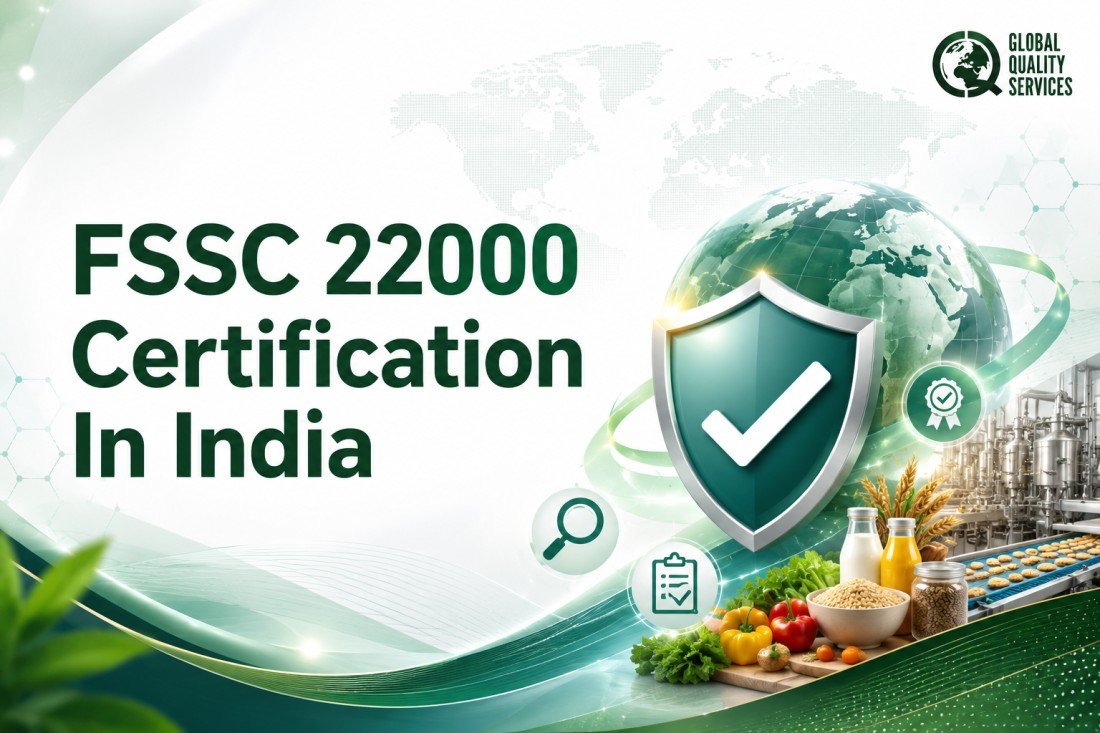
FSSC 22000 stands for Food Safety System Certification. It is a complete food safety benchmark framework approved by the Global Food Safety Initiative (GFSI). The scheme combines three core parts into one audit structure:
- ISO 22000 Standard: This sets the base management system requirements for handling food safety risks.
- Sector-Specific Prerequisite Programs (PRPs): Technical standards like ISO/TS 22002-1 for food manufacturing or ISO/TS 22002-4 for packaging that control hygiene and operational conditions.
- FSSC Additional Requirements: Specific rules covering food defense, food fraud prevention, allergen management, and environmental testing.
FSSC 22000 gives you an internationally recognized certification that satisfies strict vendor audits from top supermarket chains and global importers.
Why FSSC 22000 Certification Is Important for Food Businesses in India
- Unlock High Value Export Channels: Buyers across North America, Europe, and the Middle East require GFSI-recognized certification before buying products.
- Exceed Local Regulatory Rules: While FSSAI licenses cover basic Indian legal requirements, FSSC 22000 expands on FSSAI Schedule IV standards to eliminate hidden facility risks.
- Prevent Food Fraud and Contamination: Documented risk management plans guard production lines against intentional tampering, fake raw materials, and accidental batch contamination.
- Build Direct Commercial Trust: Retail buyers and B2B clients choose suppliers that hold verified third-party safety credentials.
- Reduce Repeated Client Audits: Obtaining one universally accepted certificate replaces multiple custom audits from different buyers, saving time and money.
Industries We Serve Across India
We provide targeted implementation and audit readiness services for businesses across the entire food supply network:
- Food Manufacturing and Processing: Plants handling dairy, meat, seafood, bakery, spices, packaged snacks, and beverages.
- Food Packaging Material Manufacturers: Suppliers making plastic, paper, glass, or metal packaging for direct food contact.
- Animal Feed and Pet Food Facilities: Manufacturers producing processed animal feeds and domestic pet foods.
- Food Logistics and Cold Storage Units: Temperature-controlled warehouses, distribution hubs, and transport operations.
- Food Ingredient and Bio-Chemical Producers: Companies manufacturing food additives, flavorings, enzymes, and bio-cultures.
Key Benefits of FSSC 22000 Certification
FSSC 22000 certification provides food manufacturers, processors, and packaging suppliers with a complete framework to manage food safety risks, build client trust, and streamline factory operations.
- Global Market Access: Opens doors to high-value export markets in North America, Europe, and the Middle East because major international retailers and brands require GFSI-recognized certification.
- Fewer Buyer Audits: Replaces multiple custom client audits with one universally accepted certificate, saving your team time and financial resources.
- Lower Product Recall Risk: Sets up strong hazard controls and daily hygiene routines that prevent contamination, product non-conformities, and expensive batch recalls.
- Food Fraud and Defense Protection: Requires structured threat assessments that safeguard your production lines against deliberate product tampering, fake ingredients, and mislabeling.
- Competitive B2B Edge: Gives your sales team a clear advantage when bidding for contract manufacturing deals, supply agreements, and corporate tenders.
- Seamless Legal and ISO Integration: Fits smoothly alongside your FSSAI compliance and existing management systems like ISO 9001 and ISO 14001.
Our FSSC 22000 Certification Process
We follow a clean five-step framework that gets your facility certified without interrupting your daily production output:
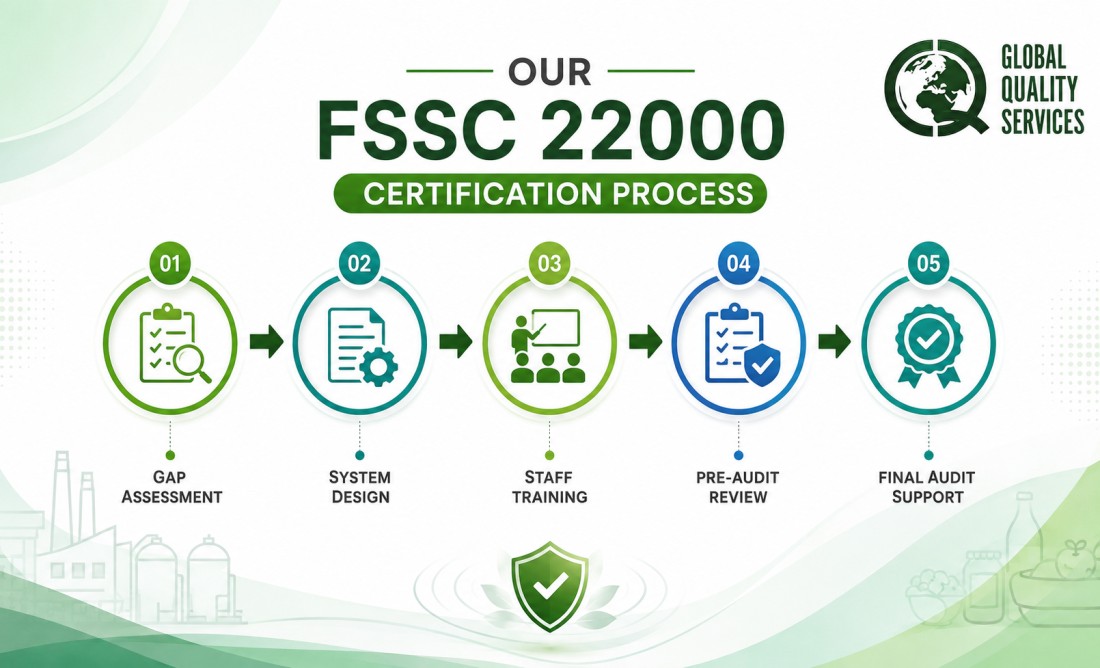 Gap Assessment: Our team reviews your plant layout, hygiene protocols, and paperwork to spot missing requirements against the FSSC standard.
- System Design: We create customized SOPs, HACCP plans, food defense procedures, and allergen control steps fitted to your exact plant layout.
- Staff Training: We train your supervisors, plant engineers, and floor workers on daily record keeping, hygiene control, and monitoring practices.
- Pre-Audit Review: We perform a complete mock audit to resolve operational gaps before external auditors inspect your facility.
- Final Audit Support: We assist your team through Stage 1 and Stage 2 audits conducted by accredited certification bodies until final approval.
Documents Required for FSSC 22000 Certification
Organizing these core records early makes the evaluation process smooth and efficient:
- Food Safety Manual: Scope definitions, management responsibilities, and plant commitment statements.
- HACCP Study and Hazard Analysis Plans: Process flow diagrams, hazard tables, Critical Control Points (CCPs), and verification schedules.
- Prerequisite Program Records: Logs for water safety testing, pest control inspections, equipment maintenance, and personnel health checks.
- Threat and Vulnerability Plans: Documented assessments covering Food Defense and Food Fraud prevention strategies.
- Operational SOPs: Written procedures for handling recalls, managing allergens, approving raw material vendors, and environmental sampling.
Secure Your FSSC 22000 Certification and Scale Your Business Today
Setting up an audited food safety system gives your business a clear edge, protects your market reputation, and opens doors to global contracts.
- Get complete hands-on support from initial gap check to final certificate delivery.
- Receive custom compliance frameworks tailored to your product lines and facility size.
- Eliminate audit stress with clear timelines and practical floor-level preparation.
Ready to prepare your factory for international certification? Contact our lead consultants at Global Quality Services to schedule your plant assessment and receive a detailed project proposal.
Migration or FSSC 22000 from Version 6 to Version 7
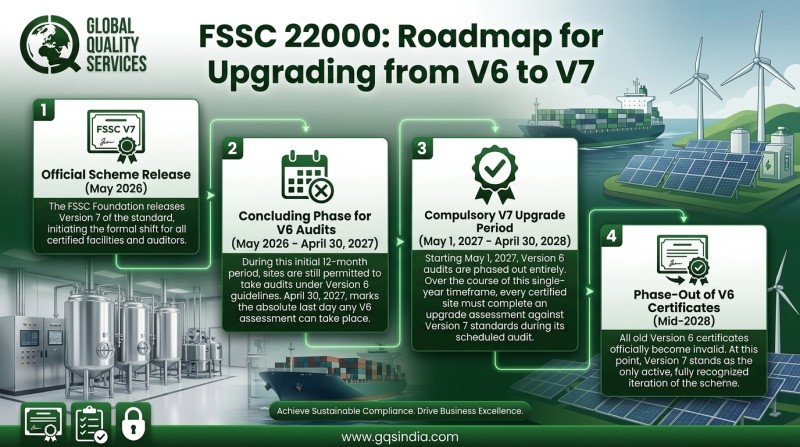
Staying ahead of food safety standards does not need to feel overwhelming. Version 7 of FSSC 22000 brings essential updates to keep your operation compliant, competitive, and trusted in the global market. Mandatory upgrade audits begin on May 1, 2027, so getting your team and documentation ready today will make your official audit stress-free.
Official Scheme Release (May 2026)
The FSSC Foundation releases Version 7 of the standard, initiating the formal shift for all certified facilities and auditors.
Concluding Phase for V6 Audits (May 2026 – April 30, 2027)
During this initial 12-month period, sites are still permitted to take audits under Version 6 guidelines. April 30, 2027, marks the absolute last day any V6 assessment can take place.
Compulsory V7 Upgrade Period (May 1, 2027 – April 30, 2028)
Starting May 1, 2027, Version 6 audits are phased out entirely. Over the course of this single-year timeframe, every certified site must complete an upgrade assessment against Version 7 standards during its scheduled audit.
Phase-Out of V6 Certificates (Mid-2028)
All old Version 6 certificates officially become invalid. At this point, Version 7 stands as the only active, fully recognized iteration of the scheme.
Summary: You can continue auditing under V6 until April 30, 2027. Between May 1, 2027, and April 30, 2028, all routine assessments must switch to V7. By mid-2028, V6 will be completely retired.
FSSC 22000 Certification Consultants
FSSC 22000 Certification in Delhi | FSSC 22000 Certification in Bengaluru
FSSC 22000 Certification in Noida | FSSC 22000 Certification in Hyderabad
FSSC 22000 Certification in Ahmedabad | FSSC 22000 Certification in Chennai
FSSC 22000 Certification in Pune | FSSC 22000 Certification in Mumbai
How Does Global Quality Services Support FSSC 22000 Certification Across India
Navigating complex compliance frameworks needs direct plant experience. Global Quality Services delivers simple, practical solutions that transform rigid international rules into manageable daily plant routines.
- Certified Lead Auditors: Our team brings decades of sector experience to guide your plant through complex technical audit checks.
- Complete Project Support: We manage the process end to end, including layout reviews, document creation, staff training, and audit coordination.
- Plain Language Guidance: We avoid confusing technical jargon and give your plant teams clear, actionable work instructions.
- Fast Implementation: Our structured planning shortens certification timelines while keeping your operations compliant.
GQS consultant is a Singapore Certified Management Consultant SCMC by TUV SUD and a PCQI Certificate holder 9c9fxxxx who is the right person to validate your Food safety plan and guide your company to sign off the documents required for submission to your customer seeking US FDA approval. GQS carries very good experience in implementing the FSMA requirements for Food Ingredients which go to the US market for further processing
Frequently Asked Questions
1. What is the validity period of an FSSC 22000 certificate?
An FSSC 22000 certificate remains valid for three years from the date of issuance. To maintain valid status, your factory must pass annual surveillance audits during years one and two, followed by a full recertification audit in year three.
2. Can small and medium food processors in India get FSSC 22000 certified?
Yes, small and medium enterprises can get certified. The standard applies to operations of all sizes, scaling its requirements based on your facility size, product risk level, and manufacturing complexity.
3. What is the difference between an announced audit and an unannounced audit?
Announced audits are scheduled in advance with your certification body. Unannounced audits happen without prior warning during normal working hours. FSSC rules require at least one unannounced audit during every three-year certification cycle.
4. How does FSSC 22000 help control food fraud and food defense risks?
FSSC 22000 requires your site to conduct vulnerability and threat assessments. You must maintain a Food Defense Plan to stop intentional contamination, along with a Food Fraud Plan to prevent economically motivated ingredient substitution or mislabeling.
5. Is an FSSAI license enough to start the FSSC 22000 certification process?
Yes, holding a valid FSSAI license shows basic legal compliance in India. FSSC 22000 builds on top of those basic regulatory requirements by adding international technical standards and additional safety controls required for global commercial trade.
6. Which version of FSSC 22000 must food businesses currently comply with?
As of April 1, 2024, compliance with Version 6 is mandatory. Every initial certification, renewal, and surveillance audit carried out after this date is evaluated against the updated Version 6 standard.
7. What is PCQI?
A Preventive Controls Qualified Individual (PCQI) is a trained expert responsible for creating and managing a facility’s FDA-compliant food safety plan under US FSMA regulations.
8. What is CFR?
CFR stands for Code of Federal Regulations—the official set of US government rules. Food safety standards fall under 21 CFR Part 117.
9. What is the Role of a PCQI?
A PCQI drafts food safety plans, conducts hazard analyses, validates preventive controls, reviews safety records, and performs mandatory periodic system re-evaluations.